Showing posts with label Andrew Bird. Show all posts

Saturday, December 21, 2013

Show Reviews: Andrew Bird Gezelligheid and King Krule in San Francisco

I'd not been to a single live show this year until last week.  It was a plan that had been made for at least two months in advance and it was a devious one, indeed.  Andrew Bird one night, King Krule the next.  It seemed almost too good to be true that such a coincidence was occurring, but alas, here I am a few days later and still basking in the wonderfulness I experienced. 

Staying in SF, just blocks away from the synagogue where Andrew Bird was playing, I did not mind getting away from the freezing temperatures of Reno and into the Bay Area's downright hot by comparison low 60's temperatures.  This meant, basically, a lot of walking.  And, inevitably, you see some street names in SF that are funny in one way or another.  Although it's mostly an alley now, this one was rather amusing to me for obvious reasons:
Earlier in the day, we made the walk over to Haight-Ashbury and hit Amoeba.  They now advertise their prowess in their video stock, unfortunately:
I was on a budget, so I shopped wisely and picked up mostly hole fillers for my collection:
(I'll get to them at a later date, but I will say right now that Amoeba's prices on used items have gone up in the last few years, but if you know what you're shopping for, the place still remains an absolute dream of a record store for nerds like me)

As I mentioned, Andrew Bird was playing the Sherith Israel synagogue.  A venue presumably picked for its acoustics and certainly did not disappoint in that regard.  It's an absolutely beautiful piece of architecture and the time spent waiting for the show to begin passed quickly, just admiring the gorgeous attention to detail throughout the place:


The before show house system played a strange, but somehow fitting combination of crackling Carter Family songs and newer solo instrumental guitar work by the likes Bert Jansch (among others).  Andrew played essentially alone, although he was joined by a bassist (whose name I unfortunately did not catch) and Tift Merritt later in the set (and boy did their harmonies sound great!).  He played two sets that lasted about fourty minutes a piece and there wasn't much stage banter or song title announcements.  He started out with one of the instrumental songs from his newest I Want to See Pulaski at Night EP (and then closed the first set with the title track from that EP) and then played a combination of older songs ('Dear Old Greenland'!!), a few from Break it Yourself and a handful of cover tunes, by both contemporary and classic sources.  All of the older material received slight arrangement adjustments and tweaks that made them sound as fresh as ever, and somehow right at home in between the cover tunes.  The show was billed as "Gezelligheid" (pronounced "gah-zell-ig-hide) and the word is supposed to mean something like a relaxed atmosphere.  In that regard, Andrew definitely succeeded.  He closed with the old standy 'Weather Systems' and I have to say, of the three times I've seen him, he's played it every single time and this one was the best.  There were numerous instances where he seemed to change the words to a song because he could, made mistakes that would have gone unnoticed by anyone who didn't already know the song extremely well and, through most of the show, it felt like he was up there letting the audience in on a rehearsal.  Now, when you're as good as Andrew Bird is at what he does, this is the highest compliment that can be paid.  Because he was completely on that night.  It just cemented to me that he is absolutely one of the best musicians on the planet and even when he's basically up there screwing around, he still manages to make completely unique and beautiful music.

Tuesday was, for me, the main event: King Krule at the Independent over on Divisadero.  I'd never been there before, but I was extremely excited upon entering the place and seeing it was only about a four or five hundred capacity room.  This meant any spot in the place could be a good one.  Well, I don't want to brag, but we may have managed to get the best spot in the house:
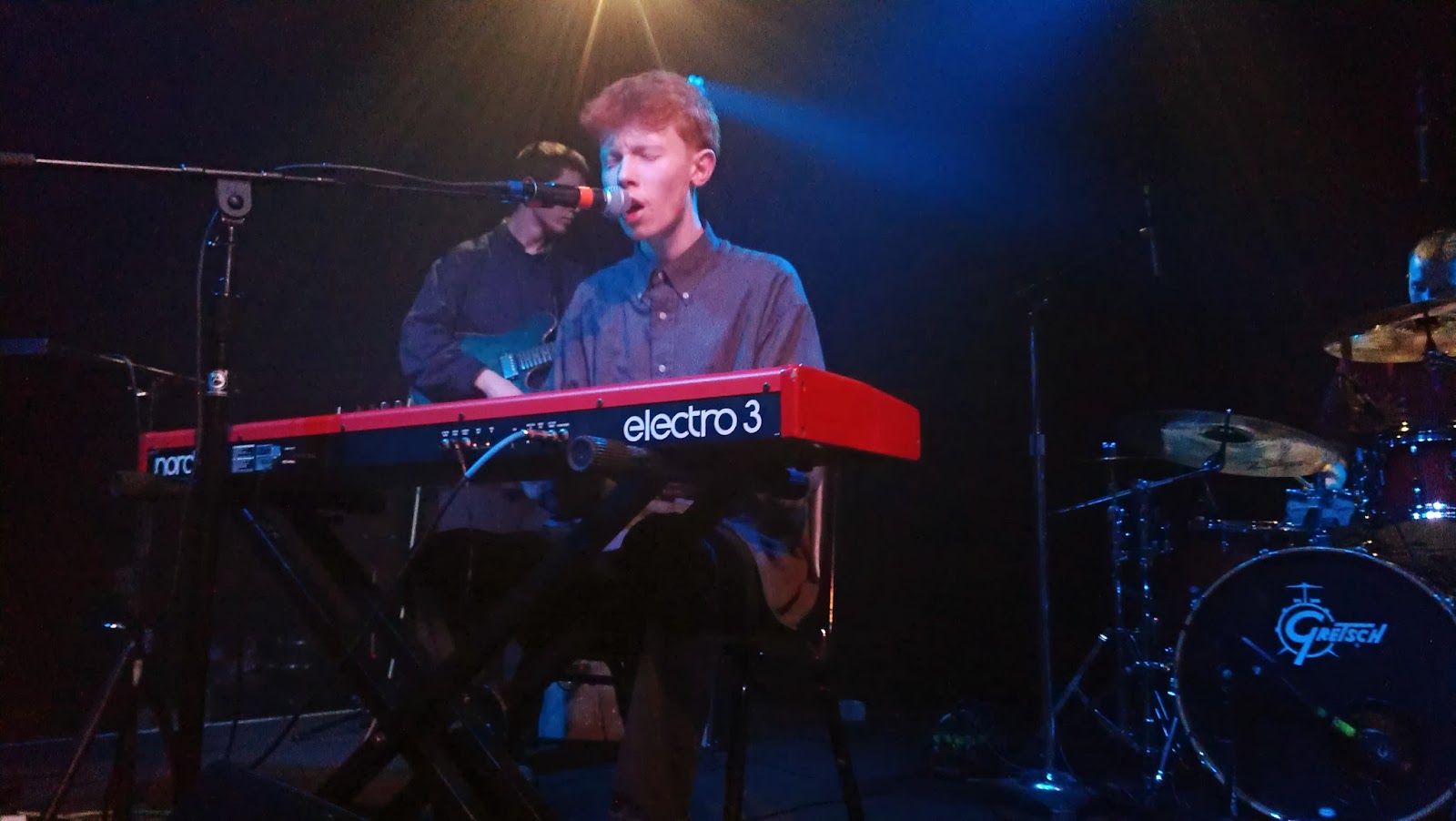
The opener was Tops (no really, that's their name).  I thought they were okay.  Angel III thought they were good, just based on how much fun they were clearly having up there.  When Archy took the stage around 9.30, I was shaking in anticipation.  Amidst dark blue lights, he launched into 'Has this Hit?' and it wasn't until the second half of the song and Archy burst into his rapping over that irresistible faux-rockabilly riff that it struck me: this is happening.  This is real.  It seemed totally surreal up until that point.  Before I knew it, he was rapping the words at me as I was rapping them right back at him.  The rest of the set just blew me completely and totally away.  His band was completely ace, and through a setlist that included a lot of 6 Feet material, sprinkled with past favorites, something occurred to me that I never thought I would say: the arrangements on 6 Feet Beneath the Moon actually hinder his presentation as a performer.  Good as the album is (and, to be sure, it's my favorite album of at least the last two years), the songs as they were played live in a more sparse, four piece band presentation hit harder and have more immediacy than on the record.  The entire set was full of energy and in the moment beauty that can only lead me to suggest that a live album is not only advisable, but necessary at this point.  The rawked up, "Fuck you, I'm punk as fuck!" run-throughs of 'A Lizard State', 'Rock Bottom' and 'Easy Easy' (with the obligatory audience singalong, no less) were bubbling over with intensity and properly controlled anger, while slower, meditative renditions of 'The Krockadile', 'Baby Blue' and 'The Noose of Jah City' ventured off into six and seven minute lengths that left goosebumps crawling all over me.  The proper set closer 'Out Getting Ribs' was not only a guitar playing clinic (less than five feet in front of my face, no less), it was the highlight of the evening (among many).  A one song encore of 'Portrait in Black and Blue' and a short handshake with the man left me with tears of joy welling up in my eyes.  There is so much contradiction in his music that having such overwhelming feelings of sureness that he is the future of music is definitely confusing.  I may make silly overbearing statements like that, but after seeing him with my own eyes, I can say one thing definitively: he is the real deal.  He is the absolute embodiment of creativity and talent. 


All that, and he totally does a "I don't care if there's people watching me" dance while he plays:
A wonderful way to end out the year.

~Austin


Tuesday, November 13, 2012

What's New?: 11.13.2012

Considering the world is about to end, it's a good thing I'm finally all caught up. . .
Richard Dyer-Bennet — self-titled (1956)

Folkways reissue of an initially self-issued album of traditional tunes.  Absolutely wonderful guitar throughout and a really diverse selection of tunes.  He has a way of presenting otherwise kind of bleak songs in a really pleasant, appealing way.  The album closing tune 'Turkish Revery' illustrates this nicely.  The whole album is on Spotify and it's a very engaging and nice listen.  Pretty good for a guy that sounds "prissy" (**smirk**).  #fuckallmusic

Magazine — Secondhand Daylight (1979)

Howard DeVoto was a not a very cheery fellow in these days.  Here's 'Permafrost.'  And yes, he says things that I refuse to repeat here.  But dude, ignoring his obvious social issues, musically this thing just blows Joy Division away, doesn't it?  Have a listen to the epic centerpiece (and probably Magazine's best song overall) 'Back to Nature' and judge for yourself.  Convenient now to recognize just how well they were blending Karftwerk and Roxy Music.  I can honestly say, if I had been there, I would have been a huge fan.  It's not that far ahead of its time, but it's a good two or three years so.  Glammy guitars + angsty lyrics + chilly synths= meet the future.  Bands still want to sound this passionate and fail miserably.  I venture to say it's an era we'll never see again.  Haha, they were contemporaries of Joy Division and people don't care!

Rain Tree Crow — Blackwater EP (1991)

One of the best songs ever gets the single treatment.  Yeah, it's only four tracks (three of which are on the proper album), but any chance I get to talk about this glorious and unfortunately forgotten classic, I'll take.  This long-deleted digipack single is very cool, with a four panel fold-out design and it has the one non-album track the band recorded.  Sure, I've had that song digitally for years.  But it's nice to finally have a hard copy.  If you've never heard the Rain Tree Crow album before, do yourself a favor and check it out.  It's on Spotify in full (with 'I Drink to Forget' appended!).  One of the watershed albums of British post-punk's last days, an important mark in the post-rock landscape and one of my favorite albums of all time.  David Sylvian is god.  RIP Mick Karn.

Andrew Bird — Hands of Glory (2012)

Andrew Bird is my nominee for musical MVP of the year.  As something released late in the year, with little fanfare, after the man has already released one of the year's best albums, a fantastic non-album single and has been on tour for most of the calendar year, it was not expected that he would release another thirty-five minutes of new music this soon.  Yes, there's some covers and a redo (a decidedly reserved and superior take on 'Orpheo Looks Back'), but to say that anything here is lesser or not worthy of inclusion on Break it Yourself would be an out and out lie.  This is just what the band was doing for fun during those sessions and the fact that it's just as resonating, even more folky and even more organic than the full length that birthed these sessions is just magical.  They played this, completely acoustic during the encore when I saw him earlier this year.  It plays up the Americana and theatrical spaghetti western feel that Break it Yourself seemed to imply on songs like 'Three White Horses' and 'When that Helicopter Comes' and there's another long instrumental that's a reprise of 'Three White Horses' and a showcase for Andrew's loop station, one man pocket symphonies.  Magical.  Play it immediately after Break it Yourself: gloriously colorful images of folky, technology-immersed Americana will fill your head.  Jesus christ, how much better can he get?!

Fotheringay — self-titled (1970)

I hate my rating system sometimes.  1 star = bad.  5 stars = good.  But blindly handing out a fiver to albums like this simply does not do them justice.  To understand why this gets the score it does, you need to go out, buy this album.  Look at the cover.  Read the liner notes.  Put it on your headphones, take a walk with it.  That's what I did, and. . . You know what?  I'm good.  I'm just. . . really satisfied right now.  Track one is epic and resonating.  Sandy Denny is god, too.  Alcoholic, flawed god, sure, but is there any other kind?  How can every song she sang be that gorgeous?  And yet, here's pretty much her first album under her own direction.  To say that this is probably the best album I've acquired since HB doesn't even begin to describe how good it is (because, let's face it: people still haven't really understood that one).  Previously, when I thought of "British Folk Rock", I thought Pentangle because that's the best encounter I had had with such a thing (and that itself is not far off from being the best band to ever do it).  But little did I know that there was an entire album as good as those previously only isolated Sandy Denny moments on Fairport albums.  I mean, honestly, this thing not only has some of Sandy's best songs ever, it actually gives me genuine chill-inducing, David Axelrod-esque moments of literal brilliance on 'The Pond and the Stream'.  And then it has 'Banks of the Nile' at the end!  Probably my album of the year, if dates didn't matter.  The best record I've heard in well over a year, at least.  This CD reissue contains four complimentary live tracks.  Any self-respecting music fan should get it immediately.  Even my highest praise does this no respect.  Obviously best ever.

The Louvin Brothers — Satan is Real (1959)

Probably more known for its campy cover art than its actual music, this came to my attention after I realized that the Byrds had covered a song from this album.  And guess what?  It's a darn fine harmony country album.  The title track, with its mid-song sermon, is a bit goofy, but that's pretty much the only tune here that's a misfire.  Just have a listen to the glorious harmonies on songs like 'The Kneeling Drunkard's Plea' or 'I'm Ready to go Home' and bask in their warmth.  The religious aspect doesn't really affect how well the material is played and sung — it would be good regardless.  The whole thing's on Spotify, so check it out.  Fancy guitar tone throughout the entire album as well.

Travis — Closer EP (2007)

Travis b-sides! Yay!  While I anticipate their forthcoming full length with growing impatience, I'll take a couple "new to me" songs any day!  These come from the sessions for Boy With No Name, so as that's one of my favorite albums by the band, my expectations were pretty high.  These two songs are alright.  'The Day Today' is a jubilant strummer, complete with a horn section; passable.  The good one is 'This Love' which, in its first half, sounds like the basis for 'Quite Free' and that's just fun.  One of the band's best choruses, as well.  The second half of the tune develops into a triumphant, fist-pumping, string section-enhanced anthem.  Anybody else wouldn't be able to pull it off, out of lack of sheer sincerity.  Fucking Travis: cornballs that really mean it. 

Belle and Sebastian — Fold Your Hands Child, You Walk Like a Peasant (2000)

Apparently, the sessions for this album were exceedingly difficult.  It splintered the band and led its leader to doubt himself for years to follow.  You'd never know that listening to the album's leadoff track.  If this band ever sees a "best of" set, that should be on it.  Where does the album lose its way, you ask?  Well, when Stuart stops directing the band and starts letting it direct itself.  A lot of it sounds like Arab Strap outtakes.  And that makes sense because it followed that album by about eighteen months.  But I'm thinking too deeply about this.  Is it good?  Yeah, definitely.  Kind of in the second tier of the band's overall catalogue, but definitely recommended if you already know you like them.  The lovely 'Waiting for the Moon to Rise' is a memorable one in that regard, while 'Don't Leave the Light On Baby' boasts string and horn charts that would make David Axelrod jealous.  Most of it has a very nice, unremarkable jangly backdrop that goes down easily, but doesn't really leave a lasting impression.

Belle and Sebastian — The Life Pursuit (2006)

In which our protagonists go exceedingly twee and seem obsessed with noticeably faster tempos and keyboards.  Not bad, obviously, but in retrospect, it very much feels like a prototype for the near perfection of the formula.  Otherwise catchy numbers like 'White Collar Boy' and 'For the Price of a Cup of Tea' seemed dragged down by such heavy handed arrangements.  When an actual vintage jangly strummer does pop up, it's pretty darned great and sticks out fairly easily because of its surroundings.  Damn good song.  There is a serious slant here towards purposely "retro" sounding arrangements and that's a gift and a curse.  Because, while the band is very good at sounding like a 60's pop act, it feels a little cheap for them to be so derivative when they had previously been so good at being unique, despite their obvious influences.  I'm mixed on this one, overall.  But it's still Stuart and the gang and it's still decent, in the larger scheme.  Nice to finally have a hard copy of it.

Fairport Convention — What We Did On Our Holidays (1969)

Obvious classic is obvious.  The album begins with 'Fotheringay' which has got to be one of the most beautiful songs ever written.  The longingly romantic way Sandy sings it, the subtle harmonies — absolute perfection.  Elsewhere, they totally own a Bob Dylan song and then Richard Thompson and Sandy duet on one of the defining songs in folk rock.  Again, my rating system sucks when it comes to albums like this.  It's purely transcendent music that will endure past most things and just get better with age.  Will be listening to this album regularly for many years to come.  Outstanding.

~Austin

Tuesday, August 14, 2012

What's New?: 8.14.2012

Falling behind again. . .


Andrew Bird — Anonanimal / See the Enemy single (2009)

'Anonanimal' on Noble Beast proper, has long been one of my favorite sleeper Andrew Bird songs.  It's buried way too deep in the album's running order for anyone, other than the devoted, to really see it's brilliance.  So, gathering up the stray Andrew Bird stuff at my availability, I jumped on this 45 quickly.  And. . . it's okay.  The re-recording of the a-side doesn't differ much from the album version and 'See the Enemy' is kind of like a dub version of the song.  After this year's 'Crown Salesman / So Much Wine' single was such a nice addition to his current repertoire, my hopes were higher.  Still, good song and good mixtape fodder.

William Ackerman — Past Light (1983)

Will settles into a more stock, stereotypical Windham Hill sound on this album (his fifth overall).  Is it cheesy?  Yeah, a little bit.  There's no swingin', post-bluegrass pickin' to be found and there's only one song where Will is playing unaccompanied.  The opener 'Visiting' is pretty darn cheesy, if you ask me.  But the very next tune 'Garden' is a collaborative effort between Will and the Kronos Quartet and it's actually up there with Will's best tunes.  The one solo tune 'Pacific II' is a sparse number and also definitely a highlight.  But then, immediately following, you get 'Synopsis,' which features Mark Isham playing one of the worst synthesizer tones I've ever heard.  So, yeah.  It's up and down.  Side two is mostly a wash, drowning in cheese, but the trio performance of 'Threes' with Michael Manring and Michael Hedges is worthwhile (as is the other Michael Hedges appearance on the brief closer 'Night Slip').  The good stuff is reminiscent of Will's best past work.  The rest is pretty boring. 

William Ackerman — Conferring With the Moon (1986)

No more or less "stock" in its overall sound, but there's a slight change for the more sparse here that I really dig.  Thematically, it reminds me a lot of the Cocteau's Victorialand (coincidentally released the same year) in that it's polishing and stripping back of the essence of Will's main idea with his music.  It's calm and mostly just meditates on themes, but there's something to the tunes this time out that tells me that there was something important happening behind the music that inspired its creation.  An astute awareness of sparseness and a grasp on the importance of space is fully realized here.  A listen to Will's solo performance of the title track (which closes out the album) and I'm pretty much sold (a more arranged quartet version opens the album).  'Improv 2' (sparse twelve string loveliness) and 'Singing Crocodile' (awesomely reminiscent of Archer Prewitt's 'The Bay') are definitely in the top tier of Will's compositions.  'Lago de Montañas (Mountain Lake)' finds Will playing the charango like the boss that he is, while 'The Last Day at the Beach' is a study in odd, well thought-out chord progressions.  He should have been doing duets with Vini Reilly at this point.  Probably his calmest album, but also easily his strongest outside of his first three. 

William Ackerman — Imaginary Roads (1988)

And while Will's last album of the 80's isn't amazing, it's got a very nice "soundtracky" quality that, despite some cheesy flourishes in the production, makes for a pretty decent album.  I do kind of get the feeling that Will is playing to his audience here, but the actual themes of the tunes are darn nice.  'A Region of Clouds' (one of two solo pieces) is so reminiscent of the Durutti Column, I really don't have any other choice but to love it.  There are some intrusive synth moments, but for the most part, this is just a really nice, warm album where I don't feel like the classification of "background music" is a bad thing at all.  Closer listens may reveal the flaws, but there's only a few.  Will's liner note that begins with the sentence "I drink beer." is completely hilarious and worthwhile, as well.

Joe Pass — Virtuoso #2 (1976)

A solo jazz guitar album.  I was mainly on the hunt for this one because album opener 'Giant Steps' has been written into the sample bible by this point.  The whole rendition of the tune is good, but that ten or so seconds of looped up goodness is just pure bliss.  The rest of the album definitely lives up to its namesake, as Joe gets more out of those six strings than seems imaginable.  Considering he plays the head, comps along for himself and takes solos, all without overdubs, it's pretty technically impressive stuff.  His tone is warm and lovely throughout and the selection of tunes is pure class.  He does go off fairly often, making this more of a dedicated music nerd piece overall.  Though not without its across the board excellent moments, it will take a concerted effort to get the most out of it.

Keith Jarrett — Solo Concerts (1973)

This beautiful three record box set on the ECM label is a testament to Keith Jarrett's unwavering creativity.  While he may be too intellectual sometimes, the simple idea of him sitting down to just play what he's feeling at that particular moment, in front of a crowd of onlookers, was completely radical and brave at the time.  It's hard to think that Keith had so many ideas just flowing out his brain, but here it all is.  He will create these themes and just build on them, throwing in little flourishes and nuances.  I mean, really, there's six sides of vinyl here to be explored.  Hard to sum it up quickly here, but I'll just say that he convincingly plays pretty much every established piano style.  Music to get lost in.  There's over two hours of it here, after all.  And I've seen him in person myself.  He can hold a packed hall completely captive just on the anticipation of what he will play next.

Cal Tjader — Soul Sauce (1964)

More Tjader to re-add to my library.  Cal's getting deep into a rhythmic Latin vibe here.  The title track nearly invents salsa music before your very ears, while the follow up tune is an irreproachably strong rendition of 'Afro Blue.'  So, yeah.  As usual, Cal's out to prove he can play just as authentically as anybody.  The ballads kick butt and take names here.  'Somewhere in the Night' (spotify link) and 'Leyte' (also spotify; also a sample favorite) are so good, it'll completely blow your mind how I could have ever given this album up in the first place.  Through and through, Tjader in the 60's was just about as consistent as they come.  Is this his best one?  Well, I'll just have to reacquire the rest of them to properly decide.  But it's in the running, that's for sure. 

~Austin

Monday, May 28, 2012

What's New?: 5.28.2012

Happy Memorial Day!  Let's go. . .


Andrew Bird — The Crown Salesman / So Much Wine single (2012)
 
Two tunes not on Break it Yourself, but presumably recorded at the same time.  'Crown Salesman' is just about the noisiest thing he's yet recorded, complete with a blaring, distortion-drenched coda.  'So Much Wine' is another one that plays up Andrew's recent folk-leanings (dig the faux Neil Young solo).  As two non-album pieces meant to compliment Break it Yourself, this 45rpm 7" single is a complete success.  I understand why they were cut from the album, but I'm glad these songs were not held back.

Andrew Bird's Bowl of Fire — Thrills (1998)
 
Born of the American Swing revival in the 90's, it figures that Andrew's first mass-distributed album is very much in that style.  I lived through it and wasn't crazy about it at the time, and even now, I'd say this is probably his "worst" album just based on gimmicky it now feels.  I can say this is one instance where Andrew's lyrics are a genuine put off for me.  However, the playing is obviously pretty passionate and when the band really cooks on the opener 'Minor Stab' I can definitely dig it.  When they really start to jam, it's good, but mostly, it's just an adequate, at times catchy, Swing revival affair.  Nothing really here that indicates the unique talent that was looming below.

Andrew Bird's Bowl of Fire — Oh!  The Grandeur (1999)
 
More of the same, basically.  Andrew's vocal style becomes a bit more recognizable here, but the musical backing is just as swingin' as on Thrills.  'Wait' is a fantastic ballad and probably the highlight here.  Otherwise, this is just another pleasant precursor to what he would really become. 

Andrew Bird's Bowl of Fire — The Swimming Hour (2001)
 
In the first thirty seconds of this thing, it's immediately clear that this is not the same Bowl of Fire as was heard on the previous two albums.  Truly, Andrew Bird as we now know him, seems to be created in that pre-song ambiance before the decidedly contemporary tune 'Two Way Action' finally kicks into gear.  It's certainly a little more rocked-up than usual, but it's unlike anything that had appeared on an Andrew Bird album previously.  And that's the essence of this album: it's just about trying something new.  'Case in Point' features, I believe, the very first instance of Andrew overdubbing his pizzicati and bowed violin, so that's fun.  As a whole, this album sounds more like a gypsy rock record (think Devotchka or early Calexico) than a swing revival one and it can be now be asserted, in retrospect, as the true turning point in Andrew Bird's catalogue.  Weather Systems is probably the first album that the "new" Andrew Bird recorded, but the Swimming Hour finds him saying goodbye to his previous musical self and squeezing every ounce of possibility out of his former musical guise.  Pretty fun, when his entire evolution is considered. 

The Durutti Column — Vini Reilly (deluxe edition) (1988/1989)
 
A second proper reissue for one of the most definitive and brilliant statements ever captured by a contemporary musician.  The initial reissue from 1996 added a wealth of bonus material, all of which is left off this recent Kooky reissue from last year.  Instead, disc one of this reissue leaves the original thirteen song album as is and adds a nine song bonus disc of completely previously unissued bonus material.  I will be keeping my old CD copy of the 1996 reissue because it gathers up things that are not otherwise available, while this recent reissue adds demos and outtakes from the time period that are equally as essential.  The documentation of the different pieces of 'Finding the Sea' coming together as one is worth the pricetag on its own.  Elsewhere the demo for 'William B' is a moody and solitary piece all on its own, while the multi-part 'Sketches on Stratocaster' is a piece of Vini Reilly virtuosity that is thankfully preserved.  Between the 1996 reissue and this new version, there is now a proper deluxe edition.  Advice: program the two together and you get a thirty song, 102 minute masterpiece of a musician so happy and so bubbling over with creativity that he can hardly contain himself.  Only one of the greatest and most important albums ever.  All that and it has 'Otis' on it. Win.

The Beatles —Let it Be. . . Naked (1969/2003)
 
So many thoughts and feelings caught up in the Beatles.  Where to begin?  I've commented on some solo things recently and I should now disclose the bulk of why that is: I've come under the opinion in the last year or two that the Beatles are, in fact, overrated and obnoxious, but okay to like.  I hate that generations upon generations will have them forced down their collective throats with no obvious alternative presented.  I hate that simply adequate musicians have been elevated to the status of gods, while so many of their contemporaries have subsequently fallen into obscurity because they simply weren't as popular.  I hate that people just take them as being "the best" without actually digging and deciding for themselves.  But, all that aside, I like their actual music.  I have owned (most of) their catalogue for some time, just have never felt the desire to listen to it through most of my late 20's, out of sheer posturing and worry of what I will look like as a supposed "serious" music fan listening to the Beatles.  I guess I'm officially old enough to not give a fuck anymore, because when I was presented with the opportunity to buy this revised edition of Let it Be at a nice price recently, I leaped at it.  Let it Be has always been the ugly stepchild of the later Beatles output.  I have always loved it, with the exception of 'The Long and Winding Road', unconditionally.  Not as bloated as the White Album, more fun than Abbey Road.  I was far too into my self-obsessed "music fan too cool for the Beatles" phase when this Naked edition of the album was released to be concerned.  It's not the Let it Be album presented definitively (any Beatles scholar will remark on how the initial sessions for the album were troubled, which resulted in the album coming after Abbey Road, despite actually being completed before the Abbey Road sessions).  It is an alternate version of what actually happened during those initial 1969 recording sessions though.  Of course, at the time, I thought, "Oh, now that George is dead, Paul is doing whatever he wants."  And part of me still feels that way.  But, lookah here, 'The Long and Winding Road' is actually listenable!  The new sequencing is. . . interesting.  I don't like that 'Two of Us' (secretly one of the band's top five songs ever) isn't the leadoff song anymore, but I do like that John's previously non-album b-side 'Don't Let Me Down' is included and George's 'For You Blue' has been elevated to track three.  Otherwise, my biggest obvious complaint is that the between song bits have disappeared.  Granted, they painted a picture of the band as silly, bickering, goof-offs, but it told a story of four people that had been painted as demigods and wanted to lower their own egos a bit.  It was perhaps too real, as the infamous film that documented the sessions has remained an obscurity since its initial run.  And now, here's this new version of the album will be the one that surely good quantities of new generations get introduced to and I'm still unsure how to feel about that.  It's a valid revision, to be sure.  I have my reservations about it, but, the question remains: is it any good?  Yes, it is.  It strips the album back to its barest of essentials (which was the point all along).  It's not an improved version of the album, just a different variation.  Is it valid?  Yes.  Is it worthwhile?  Yes.  Is it better?  Nope.

~Austin