Showing posts with label Dave Brubeck. Show all posts

Saturday, April 7, 2012

What's New?: 4.6.2012 Part Two

Recent vinyl finds. . .
The Byrds — Fifth Dimension (1966)

Guess they had to make one not-so-hot album in their run of seemingly untouchable albums.  Plenty of fancy tunes though, regardless.  It just doesn't hold together as an album at all.  David Crosby's 'What's Happening?!?!' is the album highlight and one of my definitive 60's jangle songs, already.  Wonderful stuff.  Of course, this has the all time psych classic 'Eight Miles High' on it and I have to still marvel at how badass that opening vamp is.  In 1966, I imagine that genuinely did freak people out.  Side two is where the problems arise (I mean, other than there being no Dylan covers on the album), as the album just ventures off into a territory of experimentation for the sake of trying something "new man" in the face of Gene Clark's departure.  It's not bad stuff, per se.  Just everything good is up front.

Jorge Ben — Samba Nova (1976)

Jorge Ben is one of the most trusted names in my collection by this point.  This is my ninth album of his and, of the previous eight, I'd consider them all at least minor personal classics.  This one follows hot on the heels of his all time funk classic África Brasil.  But it differs in sound slightly, as it ventures back into his more traditional territory of slower, acoustic guitar-based tunes, with no horn section.  The very first song 'Oba, Lá Vem Ela' is case in point.  A mid-tempo groove is accented by a brilliantly arranged —presumably by producer Paulinho Tapajos— string section that recalls David Axelrod more than a little bit.  Elsewhere, 'O Circo Chegoo' recalls his late 60's albums with Trio Mocoto, while 'Hermes Trimegistro E Sua' is the sort of easy breezing gem that makes his music so likable in the first place.  Yes, it tones down the funk, but I prefer the more rootsy and stripped down Jorge Ben anyway.  It was a total accident of a find, and even I was skeptical after seeing the late date on it, but it's actually one of my better finds in recent times.  More "buy vinyl" propaganda: the copy of this album I found was a promo pack that came with a glossy black and white 8x10 photo and a short one sheet bio.  Just really can't get any cooler than that.

Bill Evans — Since We Met (1974)

A Bill Evans album I didn't already have!  There are so few of them, as far as the official discography goes, that I did a real live quintuple take at the cover to make sure I didn't recognize it.  It's a 70's album, so Eddie Gomez and Marty Morell fill out the trio on bass and drums respectively.  And I really don't have much else to say about it other than that it's a predictably resonating, strong and solitary performance from one of my favorite bands of all time.  The title track was a new composition at the time (and oh boy, is it a good one; capturing Bill at his tension-building best).  Side two closes out with three classics that Bill honed to perfection with this band: 'Time Remembered', 'Turn Out the Stars' and a really thoughtful 'But Beautiful.'  Hard to talk about such consistently brilliant music that's so closely related to so much other music of Bill's that I've treasured for over half my life.  Absolute perfection.  As usual.

Dave Brubeck — Time Further Out (1961)

Playing on the Brubeck group's notoriety for being able to play catchy tunes (and swing their merry arses off all the same) in time signatures other than the standard 4/4.  Hell, the meters are even listed on the album cover next to the song titles!  Been wanting to get deeper into Paul Desmond's catalogue for quite some time, so this was a nice thrift store find.  I've already got a pretty good cross section of Brubeck albums and I've yet to encounter one that wasn't fairly good and this one is no exception.  'Far More Blue' is an absolutely unabashed 'Take Five' rewrite.  But, guess what?  It's really good, too.  'Unsquare Dance' will have you clapping along, while 'Blue Shadows in the Street' sounds like the best-ever film noir soundtrack.  Great stuff.  And completely recommended if you like Time Out and are looking for the next best thing.

Fairport Convention — Fairport Chronicles (late 60's/early 70's)

I frown on compilations, normally, but this was a bargain I could not say no to.  I had roughly half of it previous, but as it contains a huge chunk of What We Did On Our Holidays (the only album of the classic Fairport era I don't have), it was of extreme interest to me.  The really juicy tidbit included here, for me, was the single-only release 'Now Be Thankful.'  Great stuff.  Other discoveries to be had here are the atmospheric and lovely 'The Way I Feel' (released under the name Fotheringay) and the epic nine minute meditation 'Sloth.'  Edit out the tracks I already had on other albums and this thing hangs together suprisingly well as a place holder until I can track everything else down.  I can only imagine what I'd think if everything here was my first taste.


William Ackerman — Childhood and Memory (1979)

More early Windham Hill stuff from the label's founder.  "New Age" debate is out the window, because the official word is that this guy jams.  'Seattle' is really the only bluegrass-y strummer on the album, as the rest of the pieces here are back to the slower, more contemplative sound that also dominates his first two albums (Childhood was Will's third proper album).  The album's first track 'The Wall and the Wind' is a good indicator the whole thing.  This time out, there is a duet with Dave Ross contributing flute to the excellent (and probably my favorite track on the album) 'Anne's Song.'  Otherwise, it's all Will's fingers doing the guitar work (save for 'Sunday Rain', which features some multi-tracked work with a gorgeous banjo line).  And, as such, it's really easy stuff to get into, especially since I liked his two previous albums so much and this is essentially an extension of them.  Wonderful music.

Van Dyke Parks — Song Cycle (1968)

Supposedly a classic.  Whatever.  Strikes me as too smarty pants for its own good.  Good tunes, in some cases though.  Just have a listen to the first track 'Vine Street' for an instance of what I'm talking about.  Beginning with a country band, jamming away and then swooping into a schmaltzy, full orchestral pop backing, Van Dyke sings about the tape you just heard.  I get that it's totally "brilliant man" with all of the "genius" backing and everything, but I just don't hear very many good melodies, honestly.  Seems like a case of presentation over actual substance.  I've sat with it for a week now and I still don't feel like anything is jumping out at me.  And the fact that the album's lone cover (of 'Donovan's Colours') is probably also its highlight should say all it needs to.  I don't get it; yet it's still decent, just based on its sound and era of inception.  This is my most negative "positive" review ever.  Hope you liked it.

~Austin

Saturday, October 1, 2011

What's New?: 10.1.2011


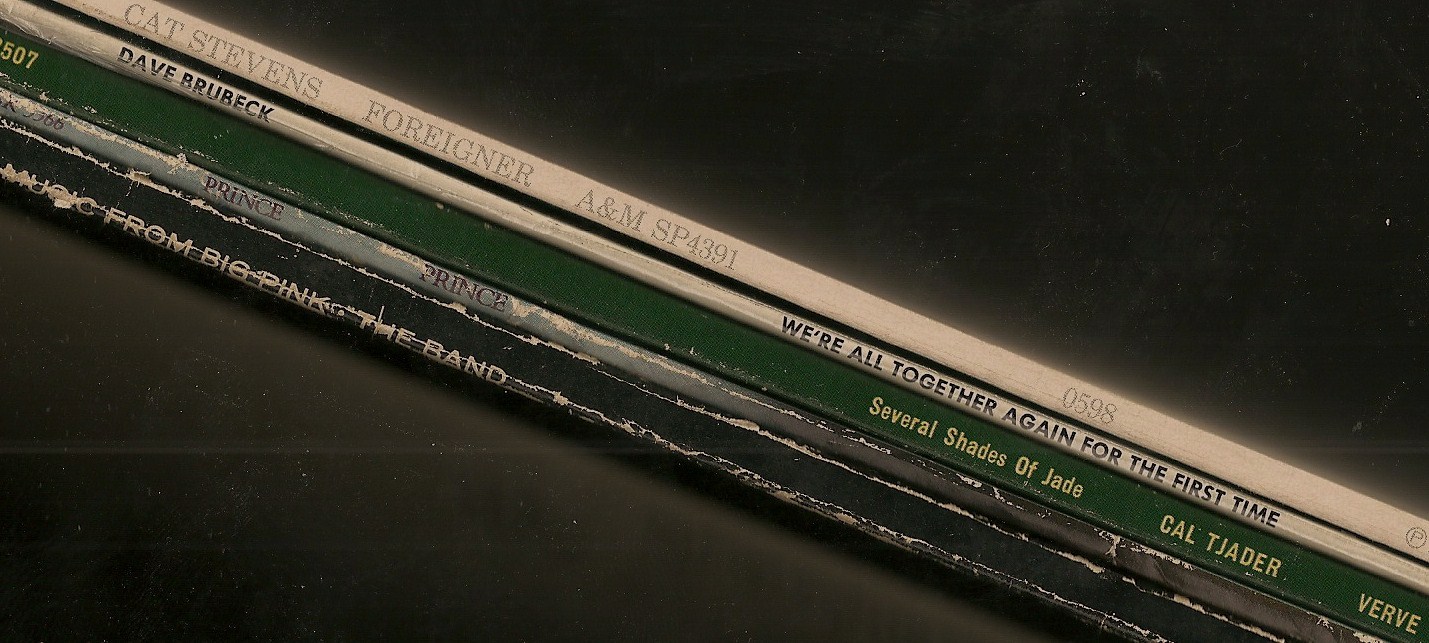
Cat Stevens — Foreigner (1973)

Filling up holes in the old Cat Stevens collection. Like all of his previous albums, this one's good, but not quite as good as the one that came before it. Still love the big budget folk rock production and his undeniably passionate performances throughout. The whole of side one is taken up by the now infamous 'Foreigner Suite' which features four regular old Cat Stevens songs (good ones, too) that are segued by doodly little instrumental half-songs. I love that sort of unnecessarily ambitious crap. The final song has the (now hilarious) little Joe Satriani/Coldplay bit — not an album highlight, but worth a mention for comedy's sake. Side two of the album just carries along in the same manner but it just doesn't sound as interesting without the willfully artsy aspect that side one has. The album closing song '100 I Dream' has got to be one of the single most uplifting songs ever. Take one look at some random lyrics: "Pick up the pieces you see before you, don't let your weaknesses destroy you." A sparse folk rock backing that mirrors his earlier triumphs and a multi-tracked harmony vocal and the deal is sealed. Good stuff.

Dave Brubeck — We're All Together Again for the First Time (1972)

The title is presumably a reference to Dave, Paul Desmond and Gerry Mulligan. It is absolutely top tier post-bop from a time when the stuff was frowned upon and in short supply. I don't know what it is, but Paul Desmond just sounds on fire throughout. Gerry Mulligan's composition 'Unfinished Woman' is a soul jazz rave-up — gosh dang, it's good. The Desmond feature on 'Koto Song' is hauntingly beautiful. Rhythm section of Jack Six on bass and Alan Dawson on drums is completely sympathetic to the dynamite frontline they're backing. There's even a super long rendition of 'Take Five' and Dave finishes the live set (recorded at two different dates in late 1972) with a solo reading of 'Sweet Georgia Brown' — completely appropriate, seeing as how it's very obvious that everyone involved was having a blast. Solid stuff. I need to explore Brubeck properly.

Cal Tjader — Several Shades of Jade (1963)

Really sweet find at a thrift store on this one. I did have this album, years back, on this two-fer CD. Overall, it looks a lot more gimmicky from the outside than it actually is. Because, for the most part, it's just Cal Tjader's group playing what they played, but with augmentation from a tastefully Lalo Schifrin-arranged orchestra. I actually didn't remember much of this album from previously, and that's surprising. Because it's actually really worthwhile. I mean, something like 'Song of the Yellow River' is just about as ahead of its time as something might get. Overall, this is probably one of the Cal Tjader albums most folks might guess is pure cheese — but after properly reassessing, I'd say it's among his best.

Prince — Prince (1979)

Sure, not his most enduring material, but there's a charm to the two early Prince albums. It's a brand of semi-disco R&B/funk that just doesn't really sound like anybody else. Because, while Lakeside and Slave were conceiving songs entirely in the studio, Prince was still writing in his bedroom. Hence, you get introspective seven minute things like 'I Wanna Be Your Lover.' It doesn't have the standouts that his first album had, but it does hang together a little better overall as an album. It has a very dated late-70's vibe to it that I must confess I like. A time when recording studios were a church of sorts and even a lesser Prince work like this one was still treated like a goldmine. Dah well, the record's good, but far from his best.

The Band — Music from Big Pink (1968)

The (other) album that the Basement Tapes begat. There's just something about this album that you feel. I can't really articulate it — but this is powerful music. I think it was George Starostin that said (or at least, he was the first person who proposed the idea as I knew it) that nobody really knows what these guys are talking about, but they are talking about some serious shit. And that comes through in this music. It's an epic collision of old meets new. Old timey ideals and ethics meet a newly discovered rocker interest in folk music and you get music that proposes something completely timeless — rare for rock music. I know it's the hit and the song that everybody knows, but I can still remember the first time I heard 'The Weight.' It is a godlike moment in music and one of my favorite songs of all time. Levon Helm's vocal performance is just about as good as it gets in my book. With my interest in Fleet Foxes reaching its most fervent phase, it's nice to go back and hear the roots. Jesus, this album is good. Makes me feel warmer just thinking about it.

The Zincs — Moth and Marriage (2001)

The Zincs' debut album is a sparser presentation of what they would become. For the most part, it's a dual jangly strummy guitar arrangement of esoteric pop songs. This one is a bit more acoustic-based than the albums that would follow, but despite the sparse presentation, the songs are just as good. There really aren't any standouts —besides Jim Elkington's bizarre lyrics— and that plays to the album's advantage, because it demands a full listen every single time. I guess this ultimately plays up Elkington's slant towards British folk rock because it does have the feeling about it that it's about the greater statement than its individual parts. Hard for a guy like me to dislike such willfully tuneful and strummy music.

Cocteau Twins — Four-Calendar Café (1993)

It sounds absolutely fine now, but I can only imagine how disappointing this must have been coming after Heaven or Las Vegas. In retrospect, it can be looked at as a very cliched stock Cocteaus sound. That sounds great these days because the band has been defunct for so long, but at the time, it must have bruised a few longtime fans' hearts. Still, Cocteaus doing "Cocteaus" is better than nothing. This album is notoriously subdued and lowkey in its production, but that actually plays to the success of mellower songs like 'Oil of Angels', 'My Truth' and the especially vintage-sounding number 'Essence.' Overall, not their best, but still a darn fine album.

Cocteau Twins — Head Over Heels/Sunburst and Snowblind (1983)

And straight back into the classics and my Cocteaus collection is complete. You can't fault albums like this. Sure, the band did better songs, but does this not hang together like a total masterpiece? 'Sugar Hiccup' is one of Robin Guthrie's most inspired moments, while 'Musette and Drums' creates the sort of building quality that most bands can only dream of. Yeesh, I mean, sure they were totally onto something new here —and would arguably repeat themselves for the rest of the 80's— but who cares when they were doing it this well? When you're in the zone, you want to stay there. And this is where theirs started.

Mojave 3 — Spoon & Rafter (2003)

After digesting —and really liking— Ask Me Tomorrow, I decided one was not enough, so I found this album used. I purposely went for this one because the first song is 'Bluebird of Happiness'. It's the only Mojave 3 song I've heard that's as good as —or, indeed, better than— Slowdive. A nine minute epic that channels Neil Young via-shoegaze, it's one of Neil Halstead's best songs ever. I just wish all of Mojave 3 was as good. The rest of the album does follow suit, in a matter of speaking. There are some twangy little ditties that toe the line between sleepy country rock and dreamy folk, but none of them have that insanely realized balance of emotion, intensity and restraint that that first track has (as the only sane person in the room asks, "What does?"). It's a lovely little album after the initial shock up front. But, I have to admit, without that first track, I would have scored the album significantly lower.

~Austin