Showing posts with label best ever. Show all posts

Sunday, April 14, 2019

What is a Serial Sound Story? (UPDATED 13 JUNE 2021)

What is a Serial Sound Story? Or S.S.S., or just sss?

It's actually all in the title. It's a story told through sound and song. But it's not a musical play, nor does it have a clear narrative, as it is completely instrumental with as little visual representation as possible. It is a story told purely through sound and sound alone; for the listener alone to interpret.  Just as the serial stories of the eighteenth and nineteenth centuries were published in short pieces across periods of time, only to be collected, in edited form, at a later time.

The idea differs in that these are sounds, not words.  Those serial novels relied on words alone to tell their stories.  No images.  No one to read the story for you.  No physical directives.  Just the words and your interpretation of them.  An sss has a real, actual story behind it for me.  But because I have chosen the presentation that I have, a listener will certainly not hear my story recited back to them.  This is intentional.  I would like the listener to create their own.

Because a "serial story" is, by nature, in the works at all times, I have decided to start a classification system.  An sss can fall into one of three categories:

1)  OPEN FOR REVIEW AND EDITING: a listener is able to hear these recordings before the final touches are put on them (though major song structures will not change — we must not lose the plot, after all), access song info before it is completed, and possibly even get a slightly different variation of the story.  Please do keep in mind, dearest friend, there is not a current catalog for changing versions posted to currently open for editing sss archives.  The only way to be sure you know the intended "finished" version is to check if the archive you're currently reviewing is open for editing or not.  Cataloging slight variations is frankly too much work for me and this is supposed to be fun, dammit.

2)  OPEN FOR REVIEW ONLY: listeners are hearing the last intended versions of these sss archives.  These archives are considered finished.  There may be new, repurposed versions of these compositions applied to other contexts, but these are considered the definitive recordings of these compositions.

3)  CLOSED: this archive is not currently available for editing or review.  It may become open for review again at some point in the future.  [This happens when Andy is discouraged, which is unfortunately more common these days.  We're being as supportive as is required.]

To answer some questions no one asked. . .

The current existing sss archives are:

Archive #1 (review only) — the best ever. :
prelude.
the best ever.
conclusion.

Archive #2 (review only) — spectral projections. :
spectral projections.
"part three."
"sunset."
part seven.

Archive #3 (review only) — Anderson. :
Anderson.
"second wind. (for jamie)"
"brooke's theme."
"moira davidson."
"mike's song."
"snow fell. (for eas)"

Archive #4 (review only) — "the many sides of the tale.": chronicles of employment. :
"the record business."
"welcome to post-9.11"
"thoughts from iglowold."

Archive #5 (review only) — Philomath. :

Archive #6 (review only) — .Sialogea. :

Archive #7 (review only) — plurmb. :

Archive #8 (review only) — Return to Sialogea. :

Unsorted chapters (these projections are not part of any specific archive and could be considered as "storyboards" for the proper archives):

And yes: archives can intersect.  the best ever and spectral projections had similar endings, and so became related in their respective epilogues.  However, again, that is my version of the story.  Maybe a different listener will have them intersect at another point.  The are, however, related.

Thank you.

~Andy

Friday, December 14, 2018

What are "spectral projections"?

After listening to MENTAL ILLNESS, an acquaintance recently asked me what a spectral projection is.  And, I will just answer that right now: I'm not sure.

I know I've been really about "astralpop" lately and most people have probably just assumed "spectral projections" was a nonsense phrase that sounds cool when you say it and is somewhat "outer spacey", so it falls right in with the theme.  While this is partially true, it does, however, have actual meaning behind it.  Most musicians or people who take music very seriously and have music as a focus point in their life have a term like spectral projections.  The nuances between each person's definitions may be small, but they are very significant.  So, for me, the idea of a spectral projection is based on a fusion of two musicians' thoughts on this subject.

The first instance of this that I became familiar with was when I encountered the great multi-instrumentalist and super unique personality of Rahsaan Roland Kirk.  Already an absolute giant in the jazz scene for well over a decade, he released a live album in 1973 called Bright Moments.  Great record and worth seeking out on its own, but for the sake of this discussion, I'm only interested in one specific part of the album: the speech that opens the title track (Roland was born blind).

(it is essential that you listen to that speech before proceeding🙂)

Already quite the orator, Roland goes into a tale of the things that get lost in translation when assessing how a listener feels about music (from different, but equally understandable positions). He even starts out his speech with, "Bright moments is like. . ."  So, right away, it's a nebulous term.  What he's saying feels like it's had a lot of thought put into.  Maybe years worth.  But when he is actually saying it, it never once feels rehearsed or premeditated.  His articulation is rushed, but completely comprehensible.  As the listener, you can feel and easily follow his enthusiasm.  He lived for those bright moments.  And I always have, too.  I just didn't know what to call them.

(if you want to learn more about Roland and his fascinating life, I highly recommend the documentary, the Case of the Three Sided Dream — respect to tREBLEFREE for hipping me to this)

So, what happens when you get into one of those bright moments, but it's not exactly the same as how Roland Kirk talks about?  Admittedly, RRK's definition doesn't quite blend with mine 100%.  His were more about the moments than the brightness, as I understand him.  So, what happens when the brightness overtakes the moment(s)?

We have to check in with London at the height of the punk explosion to answer that question.

If Bob Dylan was revered for his progressive and eloquent songs speaking in favor of civil rights and in opposition of violence, I'd like to propose that his punk-minded, heart-on-sleeve counterpart was a man named Adrian Borland.  Adrian first started out making music as the frontman of the Outsiders; very much a punk band, and of historical importance as they were the first British band to self-release a full-length, all punk album.  Like all good punks, Adrian became disillusioned with the music and the scene.  By 1979, the Outsiders had broken up and Adrian had formed a new band with a new purpose.  I've talked about them at great length on here in the past, but if you like new wave and 80s guitar rock in general, you must check out the Sound.  When they released their first album in 1979, it was a huge critical success.  The band struggled to find an audience beyond a cult following, however.

ZZZZZZZZZZZZZZZZZZZZZZZZZZZZZZZZZZZZZZZZZZZZZZZZZZ
Time out to discuss another reason I hold Adrian's words in such high regard (and yes, this is excruciatingly sad): He lived the life of an eccentric, yet incredibly gifted, songwriter who also happened to struggle with schizoaffective disorder.  While the Sound remained active and prolific throughout most of the 80s, they sputtered out after 1987's Thunder Up (a very underrated record).  Adrian plugged away, writing songs, recording, and performing on his own and with pick-up bands.  All through his life, he would often touch on his articulately unique point of view.  Sadly, Adrian succumbed to his condition in the spring of 1999, when he decided to end his own life.  His thoughts on politics and love in songs like 'Monument' and 'Silent Air' are not only amazingly prophetic to his own life, but I also happen to find them extremely heartfelt; delivered in a nearly cathartic way.  Very appropriate.
ZZZZZZZZZZZZZZZZZZZZZZZZZZZZZZZZZZZZZZZZZZZZZZZZZZ

When the band was recording their second (and arguably best) album, Adrian was determined to not just become another band with great reviews, but empty concert halls.  He believed in the power of strong, heartfelt music, and its potential to change the world.  While that may be a romanticized thought in today's scene: in Britain in 1980, Adrian saw his songs as a way to give his listeners a revolution of the mind.  Ian Curtis was dead, Thatcher was in office, the Cold War was reaching its most intense period since the 60s, and the world was in a state of general (and very noticeable) unrest.  The United Kingdom especially was struggling socially and economically.  Adrian called it the new dark age.

So, into the studio he would go, working on what he was planning to be his masterpiece and ultimate artistic statement.  He was easy going in those days, but with a very clearly-defined goal that he would not deviate from.  After recording a song to his satisfaction, he would go into the engineer's booth to listen and evaluate.  Most times, as he was quite the perfectionist when working in the studio, he would voice critiques during these playbacks that ranged from (mostly) self-criticism to anything else he could manage to constructively critique.

On some rare occurrences, Adrian would listen in total silence, with his eyes open, staring straight ahead (but not at anything in particular), through the duration of the recording (and often several moments after it had finished playing; Adrian still in silence).  And, if it was a bright enough moment for him, when someone would finally ask what he thought, he would simply respond two words: "It exists."

There was a short anecdote about Adrian using this phrase in the liners of one of the reissues of the Sound's albums, but it doesn't go as far to convey just what he meant when he would say this.  To my knowledge, he was never publicly asked to clarify what he meant by this.  So, going off what we've discussed so far, I'd like to offer up my own version of what I think he meant.  Just as Roland Kirk was unable to truly convey what a bright moment is (although he made a worthy and commendable effort), Adrian simply didn't even try.  Not because he didn't want to, but because he was unable.

He understood in his own mind that it was a moment of pure, wholly resonant, compassionate, and complete inspiration; the magnitude and significance of which he was unable to accurately state.  So, instead of trying and possibly tainting his own creation, he said the only thing about it that was absolutely inarguable.  He knew what it meant to him, but he was unable to truly translate that into words, so he left it up to his audience.

So, we come back around to the initial question:  what are spectral projections?

Now that I've established what these fleeting occurrences are to serious music people, think about it this way: Roland Kirk was trying to describe his spectral projections purely from the perspective of a listener, while Adrian Borland was describing that same feeling from the perspective of a creator.  Because I've spent most of my life solely as a listener, it didn't materialize to me until much later that the two are directly related.

So, when I start naming songs "Spectral Projections", I'm doing so because those songs are either inspired by a spectral projection, are intended to be a spectral projection themselves, or maybe they're a combination of the two.  And, even though I talk about Rahsaan and Adrian specifically, they are not the only people who have referred to interaction with music in these vague, but universal ways.  I liken the Spanish idea of "duende" to spectral projections.  In his autobiographical account of his travels across Spain, James Michener goes to great lengths to explain what "duende" means, and yet still falls short.  There is no English translation of the word "duende", and the word (being essentially an old Basque slang word) has not endured through generations; so even some native speakers are unaware of it.  But when the idea is explained to someone in more detail, they are usually able to understand the general idea, while throwing in some of their own ideas of what "duende" can be.  Sometimes, people don't even have words for this emotive thing that they experience (folks like, James Brown, Michael Jackson, and Smokey Robinson were clearly masters of their body language, in this regard).

I don't think there's any music follower or creator that would deny that this is a phenomenon that exists.  As well, I don't think there's anybody from that group that would also agree on what it actually consists of. . . not to mention, what to call it.

That is a spectral projection.

~Austin

Saturday, December 12, 2015

Archy Marshall — A New Place 2 Drown

When Archy Marshall releases new music, my world stops. Things become blurry, confused. We share a love of all things jangly, boom-bap and introspective all the same. It's a rare musical stew that makes for a combo that has molded me into the person that I am today. The kinship and connection I feel through his music is inexplicable — and yet, totally genealogical, and therefore, sensible. Because we share such similar musical backgrounds, I feel he speaks volumes about my life that I've just not yet been able to convey. It's like he says it, or plays it and I say, "Yeah, that."

So, the inevitability of him not batting a thousand with me has been in the back of my mind for some time. I knew he would eventually release something that didn't immediately floor me and I was perhaps anticipating it even more than the next thing that would.

A New Place 2 Drown was announced very lowkey, rather uncharacteristically, over his rarely used Instagram profile. And, to be completely clear, it is not new music from King Krule. It is simply the soundtrack to a short film and art book, mainly produced by his older brother Jack Marshall (who has also used the name Mr. Gone). And it does sound the piece of something greater, like it's not quite all there. It's a mishmash of Archy's electronic side. Stuttering, post-dubstep rhythms and dreamy melodic synths and keyboard washes fade in and out of each other for about fourty minutes while Archy spits a few bars here and there (he is my favorite MC, after all) and overall, I'm sure most of it was lots of fun to create. And it makes for a really easy listen. It's Archy being himself, perhaps the most personal work he's yet presented — it has been released under his real name, after all. But the song craft, the heart, the soul, the guitar playing (!!!!), it's missing here.

So, here we are, left with a stopgap album that is just simply very good, instead of monumental. Still, the last third or so of this thing is absolutely ace when he declares that, 'She won't forget me ever' and then goes on to blurt out, 'Something in the water distorted her mind. . . GIRL, this place is evil!' It gives me chills how he's able to do that.

There's absolutely nothing wrong with A New Place 2 Drown, it just feels a little short on elevation. Instead of taking a grand step forward after 6 Feet Beneath the Moon, Archy has modestly let loose a snippet of brilliance. It feels more at home with the freebies he used to give away as DJ JD Sports than it does as a proper album. But still, I awaited those bits and beat tape fragments as much as anything released officially, so to have anything new in any regard is something to rejoice, I guess.

Here's to hoping I get that genre-defying masterpiece next time. But for now, A New Place 2 Drown will hit the spot.

Album's defining quote: "We just smoke and let days roll by. . ."

~Austin

Sunday, November 22, 2015

Carla Morrison — Amor Supremo


Welcome back to the world of heartbreak. . .

Few things can prepare a listener for the kind of emotional ride that Carla Morrison takes on Amor Supremo.  Upon deep listening of her latest album, I have no doubts that she has plenty of experience on both sides of the coin ————

But I should stop there and interrupt with my own dialogue.  It would be no use for me to sit here and type away at how wonderfully gutting this album is without proper context.  I cannot claim the music of Carla Morrison as something I would just know about without someone very intimate initiating it to me in the past.  Now this person has moved on, and yet I'm still here as a big fan of the music.  It moves me like few other contemporary things.  That it just so happens to be of a very confessional, intimate nature is a deeply resonating, partially uncomfortable byproduct of the passing of time and relationships.

Look, it's a tough ride.

We all go through it.

Sometimes we break hearts, sometimes we have our hearts broken.

That this album —this grand, swooping artistic restatement of purpose and overall adjustment of a voice in a more produced, somehow even more emotional context— comes at the time that it does in my life is both perfection and punishment.  This is Carla Morrison recast: not the acoustic guitar strumming, sweet voiced songbird that sang cute little ditties about the ins and outs of relationships; not hardly.

This is the new.  The deeper.  The more complex.  The prettier.  The even more heavily resonating.  The bigger heartbreak.

The commanding, layered production of Alejandro and Demian JimĂ©nez is miles away from the mostly acoustic backdrops which dominated Carla's discography up until this point.  Lush, Disintegration-era Cure synth patches and slow, wave crashing tempos are the main touchstones here.  Where in the past, Morrison's music was direct and easily digestible, the music conjured here has a nearly bottomless, flowing feeling that's traded in the concise for the ethereal and which makes her songs ever more poignant and resonating.  Her lyrics are as direct as ever, but the presentation now makes them reverberate with much more sureness and courage.  If you've experienced love and heartbreak, this album won't simply make sense to you, it will speak to you, for you, with you.

Removing myself from the equation, this has to be viewed as a masterful artistic move and all around creative upgrade in Carla Morrison's career.  It can be a jarring listen at first.  I mean, even the songs that aren't necessarily sad are dark, minor key affairs.  The twelve string buzz of the lead off tune 'Un Beso' seems to set the bar for an evenly paced album, but things soon settle into a sauntering mood soon thereafter.  The lighter, happier tones of 'TĂș Atacas' and 'CercanĂ­a' (which begs for a house remix) will stick out immediately, but deeper listens will reveal lumbering, towering highlights like 'No Vuelvo Jamas' and the closer 'Todo Pasa' (with an especially Cure-esque guitar tone in the coda).  It isn't until the third or fourth listen that the album fully reveals itself.  To be what, exactly?  I could say something stupid like "a masterpiece", "an emotional triumph" or some other thing along those lines —which would absolutely be applicable.

But, no.  I'll just resign myself to being in a place too closely aligned with the subject matter to properly assess and assign such accolades.  I can only share my experience.  And that is one of happiness, heartbreak, isolation and pure exhilaration —whether from sadness or joy— that this music brings about.  It makes me want to experience everything —the good and the bad— all over again, without question.

Incredibly tough to get through, Amor Supremo is not only the most resonating album I've heard in years, it is ultimately simply beautiful.

Album of the year(s).

~Austin

Friday, July 11, 2014

New podcast: The Crowd pleaser: a jazz mix

All songs that have been sampled, some obvious picks, some not so obvious; all cookers though.


Crowd pleaser by Austintayeshus on Mixcloud


Enjoy.

~Austin

Friday, January 10, 2014

What's New?: 1.10.2014

A guy named ALLEN:

Bob Dylan — The Witmark Demos 1962-1964 (early 60's)

This is peak early period Bob, so if you love Bob wailin' over his own strummin', you're in heaven here.  I of course love it, but I understand that not all Bob fans will dig it as much.  The most interesting and revelatory things are the demos for The Freewheelin' Bob Dylan album.  There's enough strength in those songs that hearing them in any version is worthwhile.  'Don't Think Twice It's Alight' and 'Masters of War' in their initial, more subdued versions have a sense of calm reserve that only seems to intensify their timelessness.  Hearing 'Boots of Spanish Leather' back to back with 'Girl from the North Country' in their initial versions is just heart crushingly good.  Elsewhere, the original demo for 'Mr. Tambourine Man' shows up with Bob playing a pound and stomp piano to accompany himself and, finally, the long rumored original recording of 'I'll Keep it With Mine' closes the set out on a very poignant note.  Like I said, nothing super amazing, but for the already converted to the school of Dylan, this is more than enough to keep you occupied with obsessive listening for a while.

Bob Dylan — Live 1966 The "Royal Albert Hall" Concert (1966)

The famous concert actually recorded in Manchester at the Free Trade Hall. It's a bit awkward to listen to this in one sitting because you can hear the tension in the room. The audience politely claps after each of the acoustic performances and then when the Hawks step out to back Bob on the second half, the boos get louder and the jeers get more frequent until the infamous "JUDAS!" shout leads into an absolutely scorching 'Like A Rolling Stone' to close the show. To Bob's credit, he holds his composure quite well through the whole thing until the very end.  All the cultural baggage aside, this is an absolutely essential live document of Blonde on Blonde-era Dylan, with many of the performances here presented in such stark contrast to their studio recordings that these are very worthwhile on their own.  It's pretty much peak Bob at the height of his powers, waiting for everybody else to catch up.  For best results, play it fucking loud.

Bob Dylan — Pat Garrett and Billy the Kid OST (1973)

Pretty fun stuff, mostly instrumental.  It has a nice studio soft rock sheen that all of Bob's material of the time does.  I like this stuff, because it focuses on Bob the guitar player.  While Bob's guitar was never life changing, it certainly was hugely influential, so it's cool to hear him really just jamming out on a record for the first time.  It's mostly just repeating of theme statements, but there's nothing wrong with that, because Bob's at his most melodic here.  The big one here, obviously, is 'Knockin' on Heaven's Door' and it's become such a big one, in fact, that it's easy to look past how beautiful of a song it is because it's been played a time too many.  But, yeah, it's usually regarded as one of his best for a reason.  Besides that one big tune, there's a lot of unfamiliarity to this material, which makes going back to it pretty easy and rewarding every time.

Bob Dylan — Oh Mercy (1989)

All the stuff talked about here, and this one gets the fiver, you ask?  You're damn right, my friend.  The general wisdom with Bob Dylan is that Desire was his last really great record and anything after that, you'll be wading through a lot of garbage songs in order to get to the good ones.  But nuts to that shit, where does that leave an album like this that has such amazing tunes as 'The Man in the Long Black Coat', 'Shooting Star' and especially 'Most of the Time'?  Daniel Lanois' airy, lush production goes a long way to dress up and contemporize these tunes and they're certainly attractive in this setting, but they wouldn't be so successful if the source material wasn't as strong as it is.  Where 80's Bob is generally seen as a mess of overproduction and preachiness, this seems to be Bob really just saying to hell with all that and just following his head and heart.  This is Bob at his introspective best and Lanois' eerie, masterfully layered production only enhances that.  Even the outtakes that have subsequently surfaced from these sessions are worthwhile, highlighted by the excellently anthemic 'Series of Dreams.'  Definitely one in need of reassessing. 

Bob Dylan — Good as Been to You (1992)

You could argue that Bob had already run out of creative gas by going so quickly back to an album of all acoustic folk standards, but there's two big things that should be addressed in answer to that claim: 1) This is the first album he had cut in this vein since the early 60's.  It's only fair that he have another shot at this sort of thing and 2) The arrangements here are not exactly obvious.  So, whatever if you want to be cynical, but if you want to hear Bob getting in touch with his roots for the first time since his initial recordings, it's hard to imagine it being done more attractively.  There's not really any standouts and the album definitely sounds better when played front to back, but all the better for it, so no complaints.  I do quite like Bob's jangly take on 'Canadee-I-O' and if there is a standout here, that's it.  Certainly not for everyone, but quite good if you're into it.

Bob Dylan — World Gone Wrong (1993)

Another quick fired all acoustic album of standards.  And, just like the one right before it, it stands up really well as a singular piece.  This one is a bit more stark and feels more like a late night affair, as the title implies.  There is, however, a definite highlight on this one with the excellently dark run through of 'Jack-A-Roe.'  Definitely a worthwhile album and one that's hard to not look at as anything other than a sequel in retrospect.  Arguably the more listenable of these two albums.

Bob Dylan — Love and Theft (2001)

This, like all of Bob's latter day albums, was extremely overrated when it came out.  I was working in two record stores simultaneously when it came out, so I heard it a lot and I was always a little skeptical of how much praise it received.  After a bit of time has passed, I can hear it as a semi-decent later album.  The production is certainly warm, masking the somewhat pedestrian nature of some of the material.  It has a kind of forced old timey music hall sort of feel — the sort of thing that just occurred on past Dylan material like the Basement Tapes now serves as a blueprint of sound to aim for and it's always hard to catch that sort of spontaneity twice.  As far as highlights, the jaunty faux rockabilly of 'Summer Days' is certainly fun, while the closing ballad 'Sugar Baby' is one of Bob's prettiest songs of recent years.  This is the deluxe edition that inexplicably includes two rare acoustic demos from the early 60's.  Not anywhere near anything resembling coherence as far as being included here, but I'm not complaining.

~Austin

Saturday, December 21, 2013

Show Reviews: Andrew Bird Gezelligheid and King Krule in San Francisco

I'd not been to a single live show this year until last week.  It was a plan that had been made for at least two months in advance and it was a devious one, indeed.  Andrew Bird one night, King Krule the next.  It seemed almost too good to be true that such a coincidence was occurring, but alas, here I am a few days later and still basking in the wonderfulness I experienced. 

Staying in SF, just blocks away from the synagogue where Andrew Bird was playing, I did not mind getting away from the freezing temperatures of Reno and into the Bay Area's downright hot by comparison low 60's temperatures.  This meant, basically, a lot of walking.  And, inevitably, you see some street names in SF that are funny in one way or another.  Although it's mostly an alley now, this one was rather amusing to me for obvious reasons:
Earlier in the day, we made the walk over to Haight-Ashbury and hit Amoeba.  They now advertise their prowess in their video stock, unfortunately:
I was on a budget, so I shopped wisely and picked up mostly hole fillers for my collection:
(I'll get to them at a later date, but I will say right now that Amoeba's prices on used items have gone up in the last few years, but if you know what you're shopping for, the place still remains an absolute dream of a record store for nerds like me)

As I mentioned, Andrew Bird was playing the Sherith Israel synagogue.  A venue presumably picked for its acoustics and certainly did not disappoint in that regard.  It's an absolutely beautiful piece of architecture and the time spent waiting for the show to begin passed quickly, just admiring the gorgeous attention to detail throughout the place:


The before show house system played a strange, but somehow fitting combination of crackling Carter Family songs and newer solo instrumental guitar work by the likes Bert Jansch (among others).  Andrew played essentially alone, although he was joined by a bassist (whose name I unfortunately did not catch) and Tift Merritt later in the set (and boy did their harmonies sound great!).  He played two sets that lasted about fourty minutes a piece and there wasn't much stage banter or song title announcements.  He started out with one of the instrumental songs from his newest I Want to See Pulaski at Night EP (and then closed the first set with the title track from that EP) and then played a combination of older songs ('Dear Old Greenland'!!), a few from Break it Yourself and a handful of cover tunes, by both contemporary and classic sources.  All of the older material received slight arrangement adjustments and tweaks that made them sound as fresh as ever, and somehow right at home in between the cover tunes.  The show was billed as "Gezelligheid" (pronounced "gah-zell-ig-hide) and the word is supposed to mean something like a relaxed atmosphere.  In that regard, Andrew definitely succeeded.  He closed with the old standy 'Weather Systems' and I have to say, of the three times I've seen him, he's played it every single time and this one was the best.  There were numerous instances where he seemed to change the words to a song because he could, made mistakes that would have gone unnoticed by anyone who didn't already know the song extremely well and, through most of the show, it felt like he was up there letting the audience in on a rehearsal.  Now, when you're as good as Andrew Bird is at what he does, this is the highest compliment that can be paid.  Because he was completely on that night.  It just cemented to me that he is absolutely one of the best musicians on the planet and even when he's basically up there screwing around, he still manages to make completely unique and beautiful music.

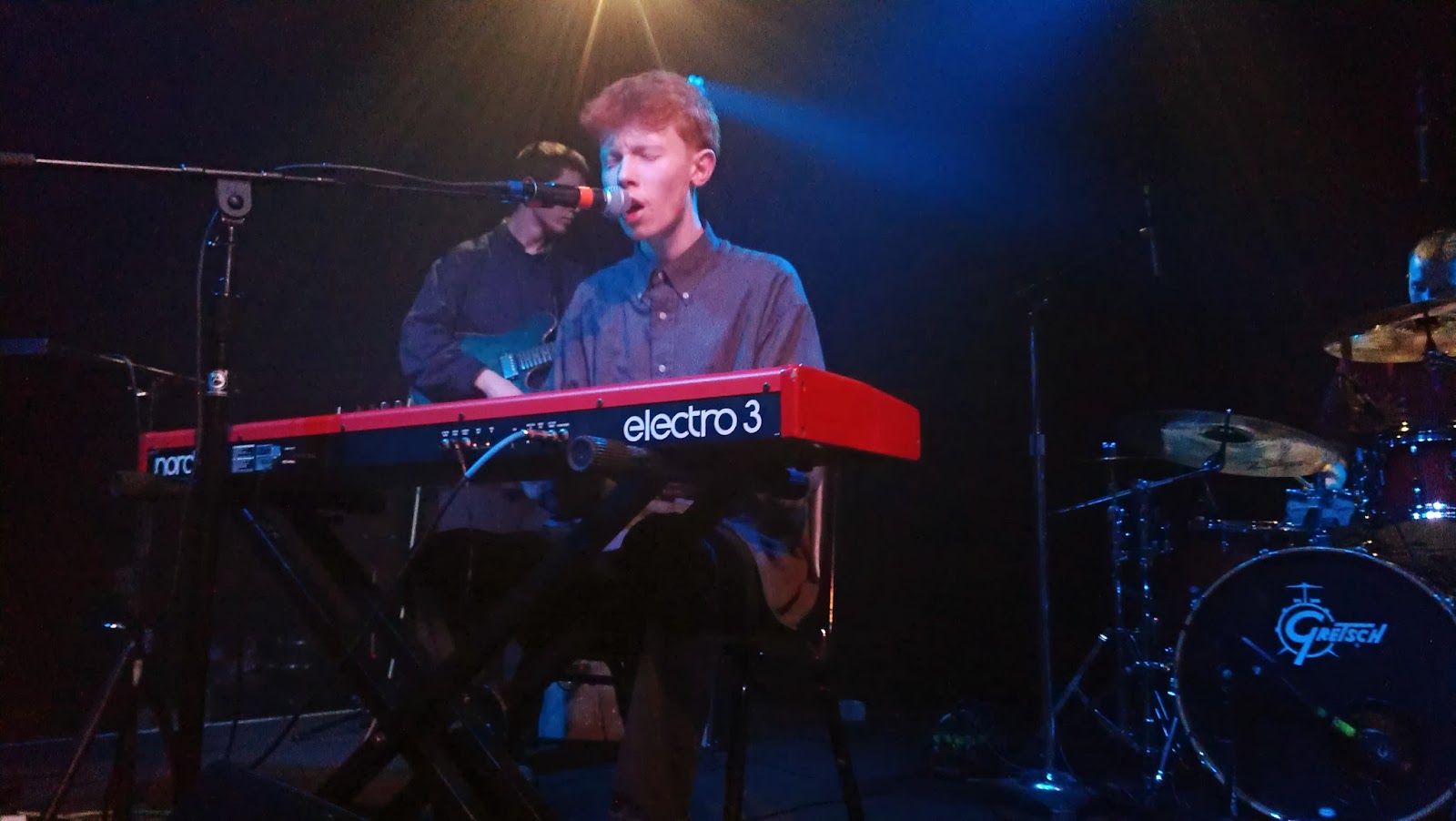
Tuesday was, for me, the main event: King Krule at the Independent over on Divisadero.  I'd never been there before, but I was extremely excited upon entering the place and seeing it was only about a four or five hundred capacity room.  This meant any spot in the place could be a good one.  Well, I don't want to brag, but we may have managed to get the best spot in the house:
The opener was Tops (no really, that's their name).  I thought they were okay.  Angel III thought they were good, just based on how much fun they were clearly having up there.  When Archy took the stage around 9.30, I was shaking in anticipation.  Amidst dark blue lights, he launched into 'Has this Hit?' and it wasn't until the second half of the song and Archy burst into his rapping over that irresistible faux-rockabilly riff that it struck me: this is happening.  This is real.  It seemed totally surreal up until that point.  Before I knew it, he was rapping the words at me as I was rapping them right back at him.  The rest of the set just blew me completely and totally away.  His band was completely ace, and through a setlist that included a lot of 6 Feet material, sprinkled with past favorites, something occurred to me that I never thought I would say: the arrangements on 6 Feet Beneath the Moon actually hinder his presentation as a performer.  Good as the album is (and, to be sure, it's my favorite album of at least the last two years), the songs as they were played live in a more sparse, four piece band presentation hit harder and have more immediacy than on the record.  The entire set was full of energy and in the moment beauty that can only lead me to suggest that a live album is not only advisable, but necessary at this point.  The rawked up, "Fuck you, I'm punk as fuck!" run-throughs of 'A Lizard State', 'Rock Bottom' and 'Easy Easy' (with the obligatory audience singalong, no less) were bubbling over with intensity and properly controlled anger, while slower, meditative renditions of 'The Krockadile', 'Baby Blue' and 'The Noose of Jah City' ventured off into six and seven minute lengths that left goosebumps crawling all over me.  The proper set closer 'Out Getting Ribs' was not only a guitar playing clinic (less than five feet in front of my face, no less), it was the highlight of the evening (among many).  A one song encore of 'Portrait in Black and Blue' and a short handshake with the man left me with tears of joy welling up in my eyes.  There is so much contradiction in his music that having such overwhelming feelings of sureness that he is the future of music is definitely confusing.  I may make silly overbearing statements like that, but after seeing him with my own eyes, I can say one thing definitively: he is the real deal.  He is the absolute embodiment of creativity and talent. 


All that, and he totally does a "I don't care if there's people watching me" dance while he plays:
A wonderful way to end out the year.

~Austin


Wednesday, December 4, 2013

Favorites of 2013

Here's a mix that contains all my most favorite music released in the twelve months since I did my last mix of a similar nature.  This has been one of the best years for new music in quite some time.


1)  King Krule — Easy Easy
2)  My Bloody Valentine — she found now
3)  The Ocean Blue — Sad Night, Where is Morning?
4)  ChameleonsVox — Heaven
5)  The Appleseed Cast — Cathedral Rings
6)  Atoms for Peace — Before Your Very Eyes. . .
7)  Sigur RĂłs — Ísjaki
8)  Juana Molina — El Oso de la Guarda
9)  King Krule — Foreign 2
10)  Kitchens of Distinction — Photographing Rain
11)  Sam Prekop — Pavillion 15
12)  The Ocean Blue — Fast Forward Reverse (prelude)
13)  The Ocean Blue — Fast Forward Reverse
14)  My Bloody Valentine — new you
15)  Travis — Reminder
16)  Andrew Bird — Pulaski at Night
17)  Mazzy Star — California
18)  William Tyler — Country of Illusion
19)  Shuggie Otis —Black Belt Sheriff
20)  King Krule — The Krockadile
21)  William Tyler — The World Set Free

 If you're goin' through hell, we just keep goin'.

~Austin

Monday, October 28, 2013

A Solbakken starter mix.

I was going to try and do an "In a Nutshell" post for Solbakken, but it would have been a difficult read for pretty much anyone except its author.  All five star ratings and impenetrable tangents of adjectives trying to convey just what it is that I love about them so dearly.  So, here, I will try to put the aborted "In a Nutshell" in its own nutshell: they are dark, noisy, sometimes too slow to bare, catchy, complicated, heartfelt, sometimes too fast to bare, passionate and they sing about isolated, yet inexplicably human things.  They are one of the most perfect bands to listen to in winter (maybe because their music is so warm, humane and coldly comforting — I don't know, honestly).  I have discussed them and my history with them here and here and now that I've finally reacquired their full catalogue (for a second time!), I've decided to ditch the words and let the music do the talking.  One of the best bands ever.  Just wish more people knew who they were.  In an effort to spread the word, here's my own version of the Best of Solbakken.


Tracklist:

Stream:


Download.

Solbakken has been dormant (and presumably broken up) for almost a decade now. I've only been able to keep up with guitarist Empee Holwerda's post-Solbakken band Kanipchen-Fit (and it's very good, very Solbakken-ish). Their albums are exceedingly difficult to find, so this mix was partially made to provide a listening party for those who are unable to obtain them.

Enjoy. I certainly do.

~Austin

Monday, August 26, 2013

King Krule — 6 Feet Beneath the Moon


It should be mentioned before I even begin this review by saying that this is not actually a review as much as it is a very personal meditation on my own life as a music fan.  In fact, let's just cut to the review right now: this is a masterpiece of brilliant, poignant, essential, life-affirming and life-changing music.  Everyone should learn and sing these songs for the rest of time.

I don't remember it being very hot, or there being much rain (for a change).  It was around the 4th of July, 1996.  I was able to play basketball without sweating to a drip, at least.  The outside light by the garage had a burned out bulb and Grandpa Andy had not replaced it yet.  So, this meant I had about three-quarters of an hour to play a little more after dinner, but after that, I would maybe watch TV or something. 

I usually hated music videos.  The visuals, that is.  I loved the music.  That's why I would switch to MTV or the Box as soon as I got the remote.  So, it was late that night when I finally gained the remote control for the evening.  MTV was in the middle of a Real World marathon, so over to the Box.  It was somewhere in the second half of the video.  Second chorus, where the bouncing karaoke alien head tells you the words.  I recognized the voices right away.  "This is new OutKast," my mind told me after about twenty seconds. 

It would be nearly six weeks before I would actually hear that song again, when the album came out the 27th of August (oddly enough, the proper US release date for 6 Feet Beneath the Moon is the same).  I worked hard around the house to get my mom to buy me ATLiens that Tuesday.  Got it home, put it on and just stared at the stereo for about an hour.  Time didn't stop initially, but when the album was over, it felt like maybe fifteen minutes had passed.  It was the single most spiritual moment of my life up until that point.  I understood about a billionth of what happened in the world and why, but this album —this music— made me not only cower in the sheer overwhelming behemoth of such thoughts but also washed me over with what can only be described as intense fascination with the whole lot of it.

That was the first time music changed the way I thought about the world.  It made me dig deep into myself to reach an area of introspective clarity that's guided me in my everyday life, in varying degrees, ever since.  There were a lot of these kinds of albums when I was younger.  One a year, it seemed.  All have a back story and I can recall the exact circumstances surrounding them.  The last album that I really remember clutching onto my heart and mind with this much strength was Helplessness Blues (2011) .  Before that, David Axelrod (2001).  Before that, Like Water for Chocolate (2000).

They're getting fewer is what I'm trying to say.  And certainly, my age has a lot to do with that.  I am not able to romanticize things in my  now mature mind the way I once did.  So, immediately, everything is to be criticized before it can be properly enjoyed.  There is so much caught up in listening to music these days besides actually just taking it in for what it is.  My overly analytical music dork mind just doesn't allow me to let my guard down very often. 

Anybody who's read Redundant Chicanery for a while knows how highly I think of King Krule.  His words, his guitar playing, his unearthly voice and, most of all, his gift of being able to write such gorgeously resonating songs. 

The arrangements of earlier songs (and indeed, some of the earlier versions of the songs on this album that first appeared on Archy's Zookid Bandcamp page in 2010) were like prototypes for the sound of the songs on 6 Feet Beneath the Moon.  They sounded like what they were: the bedroom recordings of a teenage boy.  But the songs themselves sounded from another planet.  Classic rockabilly guitar colliding with modern drum machines, keyboards and a baritone singer that sounds equal parts classic crooner and shouting soul singer that speaks years of maturity beyond his age.

Just how good some of these songs are is truly remarkable.  These are not just some songs banged out by a teenager and then moved on from.  A look at Archy's old Bandcamp page liner notes for each song reveals a person who poured their entire soul into them. 

The variety is astonishing: the jangle pop of 'Border Line'; the spliffed out angry faux James Brown of 'A Lizard State'; the nearly hip hop beats on 'Will I Come' and 'Bathed in Grey'; the woozy love drunk dream pop of 'Baby Blue'; the seeming sound of J Dilla's soul floating in space on 'Foreign 2'; or even the MPC-meets-big band on 'Neptune Estate.'


Some of these songs are years old.  Proof positive that the truly best music is timeless.

It's what I listen to music for.

Album of the year(s).

Thursday, June 13, 2013

David Axelrod — David Axelrod (2001)

And now, as a stopgap, a previously unissued outtake from my decade wrap up. I did this for a website, which I don't currently recall, but it was never used. The idea was to pick one highlight album for the 2000-2009 decade and write about it. So, I made the obvious choice. This probably dates from around December 2009 or January 2010. Here 'tis:
. . . . . . . . . . . . . . . . . . . . . . . . . . . . . . . . .
David Axelrod — David Axelrod (Mo’Wax, 2001)

To say that the timing of when this album was released played a part in the high regard in which I now hold it would be perhaps one of the biggest autobiographic understatements I could possibly make. I had just recently completed my David Axelrod catalogue about six months previous and had really digested everything fully and unfortunately found myself at a dead end after a three year odyssey of seeking and finding an engaging stream of elusive and endlessly rewarding albums that weren't similar in neither substance nor quality to anything else with which I was previously familiar. It was a moment of now unfamiliar stagnation in my listening habits. There were no more David Axelrod compositions with which I was unfamiliar. In addition to the Axelrod catalogue, it was back to Miles at Fillmore East and Sun Ra's Lanquidity if I was in the mood to have my listening ear challenged and my musical heartstrings tugged at in equal measure. But still, there was a definite and unmistakable feeling of emptiness: there was no more that would be new to me.

Fast forward six months.

I bought it on Japanese import for nearly three times the domestic price because I could hear it a matter of days sooner than if I had waited for the domestic version.

It was worth every penny.

I didn't know this going into my first listen of the album, but —perhaps in the ultimate of Axe-o-phile dreams come true— the bulk of the album was built from acetates of unfinished tracks from the late 1960’s. Sure, they were only decaying rhythm section structures, but the vibe was there.

That feeling.

That challenge.

Those irrecoverable moments, denying the laws of physics and of plain old common sense, being literally resurrected before one’s ears.

Carol Kaye on electric bass in her prime? Earl Palmer shuffling a swamp beat on cue? The then deceased for nearly a decade Howard Roberts belting out his effortless perfection? Don Randi sitting at the piano, playing block chords with one hand and counting his bankroll with the other?

All present. All captivating.

It came out in the years following its release that the tracks were for a doomed third album that Axe was to do under the Electric Prunes guise; a theme album based around Goethe’s Faust. Sure, that now sounds pretty ‘heavy man’ and all well good, but even a casual listen to the album puts some light onto those in between bits surrounding such monuments like Songs of Innocence and Earth Rot.

For instance, ‘The Dr. and the Diamond’ would be right at home on Songs of Experience while things like ‘Fantasy For Ralph’ and ‘For Land’s Sake’ sound plucked from the sessions for the Messiah album and ‘Jimmy T’, with its shrill wordless choir, seems a dead ringer for an Earth Rot outtake. Sure, this music sounds of its time, but nothing else —then or now— sounds even remotely like it.

So, if it seems formulaic in comparison to his previous works, that makes sense for two reasons:

#1) The works are basically finished demos from a specific time period, inevitably recalling the finished works of the time and

#2) They are the compositions of David Axelrod. With Earl Palmer on drums or not, with vocals or without, his music has a strangely strong cohesion and unification to it that can be accurately described as intensely passionate and passionately intense.

For the hip hop heads and aspiring beatmakers that were hipped to Axe through his two or three (oft-sampled) big open drum breaks — and then, upon seeking out the original recordings and putting those —admittedly, now seemingly insignificant— breaks into context, it was truly a revolution of the mind. But it was still always great to hear the break. And there’s plenty of them to be heard on this album. As Earl Palmer was the drummer on all those late 60’s sessions, he is at the rhythmic helm for the duration here as well. Numerous open breaks and downright incredible MPC-feeding moments are littered throughout the album; but perhaps never more than on the epic highlight, ‘The Shadow Knows.’

Named in homage to DJ Shadow, the tune is an appropriately slow, purposely leisurely dirge through dissonant minor changes and rewarding buildups and subsequent breakdowns. Don Randi plays a Hammond B-3, Earl gets countless solos, Carol Kaye holds down the low end with a dizzying array of tonal colors, Howard Roberts wails away and second (and criminally underrated) guitarist Peter Wyant provides some stinging light distortion.

It captures what I feel is the essence of Axelrod’s music: Los Angeles in the late 60’s in the early morning hours after a night of who knows what. And, in a moment of venerability, a moment of unsure apprehension, things become clear. Things become simultaneously unachievable and completely real. In that brief moment, you realize you are a living, breathing organism among trillions of other such things on this lone, mostly water covered rock, floating through the unknown. It’s a scary feeling. You kind of like it regardless. This music sounds literally like the undying fear of, and coexisting fascination with, the unknown.

There were two then recently recorded vocal works that book ended the album and they were, at once, the past and the —still, unfortunately, unrealized— present of David Axelrod’s music.

The first of the two was 'The Little Children,' the first track on the album and appropriately featured Los Angeles rapper Ras Kass —who previously had rapped atop an Axelrod sample on the Diamond D remixed version of his own ‘Soul On Ice’— snarling social commentary on top of a chaotic, and completely drum-less, Axelrod string arrangement: a peak at a direction hip hop could’ve gone, but didn’t.

The second was the last track on the album. A collaboration with Lou Rawls, whom Axe had done uncountable sessions with in the 60’s, titled ‘Loved Boy.’ It was a dark, dreary and curiously enthralling paean to Axe’s long-deceased son. Rawls sings of young Scott Axelrod, ‘Rest in peace and when asked, say: Here lies a man’s best work.’

Indeed.

Just excuse the thirty three years tardiness.
. . . . . . . . . . . . . . . . . . . . . . . . . . . . . . . . .

Regular updates will pick up again soon. I promise.

~Austin

Wednesday, January 23, 2013

What's New?: 1.23.2013

A batch of seven inch singles. . .
Bill Withers — The Gift of Giving / Let us Love (1972)

Rarely heard non-album action from one of the best ever.  The a-side here is a typically melancholy number for Bill.  Making good feelings about family and acquaintances into a minor key introspective tone poem masked as a holiday song.  Super warm, super deep; still Bill.  The flip is a tune called 'Let Us Love' that was performed on Bill's live album, but this is the almost never heard studio version here.  It continues in the holiday theme, but I really dig the message of the tune: be nice all year round.  If you like someone, let them know.  Don't fake it for a month or so at the end of the year.  Really a hard song to dislike.  

Carla Morrison — Una Salida / Tu Luz (2011)

The only instance I've found of Carla's music on vinyl.  And, yes —and I do mean YES— it is a good one.  The a-side is one of her best ballads.  Aching, building and beautiful, it's the reason I love her music.  The b-side is 'Tu Luz.'  And while the song starts out as a typically pretty acoustic Carla Morrison ballad, by two minutes in, it builds to a dreamy, towering, piano-laced wall of sheer beauty.  One of her dreamiest tunes, it's the clear winner on this single. 

David Axelrod — Theme from "Gumshoe" / The Lost Lament (1972)

Super essential, but unfortunately rarely heard non-album single produced and arranged by the man himself.  The timeline of this single is just insane: Axe was fresh off the death of his son, recording the Pride album (easily one of his best works), quickly slamming out his blue-eyed soul rendition of the Messiah and then to work on his bluesy funk rumination on the slave trade.  Somehow, in the middle of all that, he found time to reassemble a good portion of the band that had recorded his classic albums on Capitol for this completely inexplicable (in retrospect) non-album single.  For me to sit here and type out how good it is is redundant at this point.  This is simply my acquisition of this record in physical form.  Thanks to one of the current internets, I've known these tunes for a few years now.  The a-side may seem gimmicky upon initial glance, but it's given the vintage Axe treatment and the result is fanboy fodder of the highest order.  The flip is a little tune called 'The Lost Lament' and, as a greenhorn Axe scholar, I'd venture to say it's probably in the top five most important original David Axelrod songs of all time.  Keen listeners may pick the tune out as something Axe would redo a couple years later in a more polished fashion.  But listen to this initial rendition of the tune.  It's huge.  It's aching.  It's triumphant.  It's funky beyond belief.  I don't know whether to dance or cry.  It's just complete musical perfection.  There's a reason he is the best ever.  This is just one contributing factor.  Roughly six minutes of music and I'm still babbling on, years later, about how incredible it is.  I finally own this vinyl for myself.  It's a musical monument for me: I can now say I own every record this man has ever made under his own name.  Finally.

~Austin

Sunday, May 6, 2012

For your information, Vini Reilly is an excellent person.


I don't know.

It's late.

I've been thinking about this.

He's obviously better at making music than most.

But, I don't know. 

Just knowing that he is there, recording beautifully noodly little vamps into his portastudio just makes me feel hopeful about the world around me.  It's as if he's just this little sub-universe unto himself and anybody that hasn't heard LC or Idiot Savants hasn't ever known true beauty and an actual lust for life.

His personal struggles, his demons.  Love, loss, death, unimaginable pain and pleasure are all found in his music.  To know his music is to know the understanding that life outside the womb is confusing as hell, but ultimately, worth the journey if for nothing else than the scenery.

His is a music of world-weary, life-affirming brilliance.  Not everything will be golden, pretty and joyous, but it will sure as hell be worth consideration.

Proof:

Exhibit A

Exhibit B

Exhibit C

Exhibit D

Exhibit E

Exhibit F

Exhibit G

I wish he would never stop playing.

Because he is one of the best ever.


~Austin

Friday, May 13, 2011

R.E.M. in a nutshell.

I've dug back into R.E.M. after years of having a few of their early albums and honestly just neglecting them. As a fan of 8o's post-punk and indie guitar rock, it's very easy to overlook R.E.M. as one of the defining American bands of the 8o's for one simple reason: they're enormously popular. They started indie, went major, got huge, got bloated and got boring. But they've always at least remained interesting (most recently because of the circumstances and not the music; which is always unfortunate). After a conversation recently with a friend, I realized, I should say something about one of the best bands to ever do it. I will try to keep this somewhat contained to within a reasonable length, but I make no promises. Sticking to official albums and stopping where I feel like they really did lose it, here's R.E.M. in a nutshell. . .

Chronic Town (1981)


As good as they were later on, I still find that this five song EP is the most enduring and just downright best thing they've ever done. It's like a post-punk band trying to play like the Byrds. Too nervous and jittery to be able to sound so polished, but with enough (alluringly simple) melodic ideas to pull it off. All Music has famously remarked that R.E.M. marked the point where post-punk officially became 'alternative rock' and while I would agree, for this EP and its follow up, they were still playing firmly in the post-punk mindset. The guitars may jangle more than their other post-punk peers, but Mitch Easter's stark production and Bill Berry's bare bones drumming makes them sound essentially like a slightly more polished garage band. Highlight: 'Carnival of Sorts (Box Cars)' wherein Michael Stipe's mumbly jumbly vocals seem fully formed already as he babbles on about "Chronic town, poster torn, weeping wheel" and then all of a sudden explodes into, "BOX CARS ARE TURNING OUT OF TOWN. BOX CARS." Still one of the band's definitive songs.

Murmur (1983)


Where Chronic Town's presentation was sparse and no-nonsense, Murmur's production is still clear and jangly, but it sounds like maybe there is extra reverb on everything. Also, the songs are a bit more obtuse in their structure. Besides the big riff and glorious chorus of 'Radio Free Europe', most of the songs avoid traditional structure altogether. A song like 'Laughing' is just flat out sparse brilliance, as its lyrics mean absolutely nothing, but its riff is undeniable. In the end, the band never made another album quite like how Murmur sounds. It's almost ambient jangle at some points. Totally unique sound and vision. Highlight: 'We Walk' probably because it has one of the only coherent sets of lyrics on the album.

Reckoning (1984)


I wouldn't have used the word 'artsy' to describe Murmur in its own review because it only seems like it is when you consider what came immediately before it and immediately after it. Because when an album like Reckoning comes along and still sounds revolutionary despite its staunchly conservative and classicist sound, everything comes into focus. There are some days I'd call this my favorite R.E.M. album. Just based on pure songwriting, this one knocks it out of the park within the first four tracks. Peter Buck famously remarked later on that he thinks side one of this album is the best single side of a record that the band ever did. I can't say I blame him. The riffs throughout are layered and evolving, the choruses are simple and effective as hell and the sequencing and consistency of the whole thing is just tops. Truly, this sounds less like a band forcing themselves into something and more like a band trying to keep up with the creativity that was obviously bubbling over. One of the most definitive jangle albums of all time. Highlight: Still 'So. Central Rain', despite maybe slight overplayage throughout the years. It's just one of those warm, fuzzy pop singles that became popular on sheer quality. The song's stature —and the rest of the album's, for that matter— has only grown with time.

Fables of the Reconstruction (1985)


You know something's wrong when Peter Buck labors away at that nearly mathematical riff right off the bat on 'Feeling Gravity's Pull.' And make no bones about it: that song (the album's opener, no less) was the darkest and just downright bleakest thing the band had done at the time. Produced by Joe Boyd, recorded in England and bringing in some dreary string augmentations, this is R.E.M.'s slowest, darkest and just all around best album in my ears. Always has been, in fact. I like the sludgy riffs. I like the gloom. I love the slowness of the whole thing. At this point, the band could probably have farted in unison and it would've come out as a melodic idea for a glorious riff. But, when I say this album is dark and gloomy, recontextualize that for an R.E.M. setting. While you still get some pretty bleak-sounding stuff like 'Maps and Legends' and 'Kohoutek' (an extremely underrated song), it's all filtered through the band's modern folk rock slant, so it's not like the thing is competing with Joy Division or anything (well, maybe if PB had played that riff on 'Feeling Gravity's Pull' a little more sloppily and with some feedback — you get the idea). 'Driver 8' is just one of those magnificent R.E.M. jangle pop gems that sounds incredible every time I hear it. Just top stuff, man. Joe Boyd's production is a match made in heaven for this material because it's longing and melancholy, while not forgetting the bigger picture fact that this is still a guitar band trying to make a pop record. Really wonderful stuff. I often go back to it and marvel at just how damn good it is. Because it's that good. Highlight: 'Feeling Gravity's Pull' with its labyrinthine riff and weird —even for Michael Stipe at this point— surreal lyrics. Stone cold is how classic it is.

Lifes Rich Pageant (1986)


In which, the formula for the R.E.M. album, as we now know it, is formed. It rocks out a little ('Begin the Begin'), it gets folky ('Swan Swan H') and, most of all, it's got a few downright resonatingly great jangle pop tunes ('Fall on Me' and the greatly underrated political track 'Cuyahoga'). It's fine enough, I suppose. But I guess it's the first album where I find that they got a bit complacent and comfortable for the first time. A comfortable R.E.M. is not necessarily a bad thing, but it's also not very interesting most of the time. Don't get me wrong, a three-and-a-half for an 80's R.E.M. album is like a twelve hundred for any other band. But it just feels for the first time like they didn't give it their all. And the album suffers because of that. Highlight: 'Cuyahoga' because of the g'damm chorus vocals. Just heaven, they are.

Document (1987)


Different approach to production, different sounds, generally strong results. 'Finest Worksong' is an awesome, and quite brilliant, opening song. I'm almost positive I'd hate it if it were anywhere else in the album sequence. But it just opens things up, rocking out, big dated mid-80's drum sound; great stuff. And then it just awesomely jangles away like it's trying to be Reckoning or something. Can I just say that, removed from overplayage and all the cultural baggage bullshit that it picked up, I think 'It's the End of the World as We Know It (And I Feel Fine)' is really a rather fantastic song? Would that make me a bad person at this point? Because structurally, melodically, rhythmically, it's pretty fucking sharp. The harmonies, the riffs. Sheesh. I can only imagine what it was like being a teenager in 1987 and hearing that for the first time. I was only six, so as much as I would like to pretend I was that hip, all I have is a hindsight appreciation. Call it overplayed and old by this point, but what a fucking monument, in the bigger picture. I nominate it for the esteemed title of "The indie rock 'Free Bird'." And then, just guess what the next fucking song is. I dare you. Fucking guess, man. Only 'The One I Love.' One of the greatest pop singles in history followed by it's little brother. The rest of the album is good and it ends with the awesome fan favorite 'Oddfellows Local 151' but what else can you say, honestly? It's got no less than two of the best songs ever written on it. What else do you want? Highlight: 'The One I Love.' Just because.

Green (1988)


I know this is a line in the sand for just about everyone familiar with the band. R.E.M. got really popular off of Document and its two incredible singles, so off to a major record label they went and all hell broke loose. As it usually does, the hype surrounding the ethics of such a thing overshadowed the actual music. And, in this case, they just maintained. Didn't get better, didn't get worse; just made the same old class act, left field pop that they had been doing for a while. If anything, it was actually a step towards a little more willfully inaccessible music. 'Pop Song 89' is a silly goof, but catchy as heck. 'Get Up' is slow and sludgy. 'You Are Everything' is quiet and folky. 'Stand' is another amazing pop single whose popularity overshadows its actual quality. And then, the next three songs are arguably the best hat trick that the band ever pulled off. 'World Leader Pretend' is an incredible political allegory set to a dark, lush folk rock backing. It's one of the best things the band ever did (and there's a reason that it's the only song that had its lyrics printed on the album sleeve). 'The Wrong Child' is just about the most convincing thing they ever did to sound like a real folk band (and it's surprisingly affecting). And then 'Orange Crush' is just a textbook example of an anthemic single gone completely right. One of the defining albums of "alternative" rock for a reason. Maybe not their overall best, but I think I may go back to it more than just about anything else in their catalogue. Highlight: 'World Leader Pretend' because it's simultaneously pompous and catchy. Just excellent music.

Out of Time (1991)


God, I hate 'Radio Song.' I like the message, but the actual execution is pee-pee poor. Overproduced, contrived funk rock schlock. And, as a whole, this album is overproduced in the classic sense. Keyboards where they don't need to be, big boombastic drum sounds and just that all around stock early 90's big budget sheen. But the songs are good, for the most part. I like 'Shiny Happy People' just because I probably have a secret crush on Kate Pierson that I haven't fully addressed yet — but I do understand why somebody wouldn't like it. 'Losing My Religion' is, again, one of those great jangly R.E.M. singles that just ballooned out of control and got too popular for its own good. Elsewhere, 'Near Wild Heaven' is one of the rare non-Michael Stipe sung R.E.M. songs that is genuinely good. 'Belong' is a strangely catchy half-spoken thing and 'Texarcana' sounds straight out off the Reckoning demo reel (and, again, isn't sung by Stipe). Overall, a bit more folky and "weird" than you'd expect if you only knew the singles, but a darn solid effort, especially amongst the sometimes hindering production. Highlight: (surprisingly?) the two numbers where Mike Mills takes lead vocals ('Near Wild Heaven' and 'Texarcana').

Automatic for the People (1992)


I really like that the band's biggest album —the one that is, at once, their most acoustic-based, most pleasing to both their old fans and their new fans and probably the darkest of their major label albums— starts off with Michael Stipe, nearly whispering atop a Peter Buck acoustic strum, "Hey kids, rock and roll. Nobody tells you where to go." Fuggin' brilliant, buddy. Sure, 'Everybody Hurts' was so popular that even your grandparents probably know it, but take away the popularity and, again, you get a really affecting and genuine pop single. I could go without ever hearing it again, but to my eleven year old brain, seeing the video on MTV and —especially considering that I wasn't even into that sort of music— actually feeling something was pretty relevant. It's a first for R.E.M. because they had never done anything close to a power ballad at all before this, so I guess consider it significant just because of that. The rest of the album, like I said, is pretty dark and melancholy. And Michael Stipe swears a lot for some reason (seriously, what's up with that?). The other single, 'Man on the Moon,' is one of my favorite R.E.M. songs just because it captures that amazingly resonating classic pop single mood so well. The whole album is great, honestly. But don't judge it by the singles. Because you're totally wrong (even though the singles are pretty good), if you're doing that. Highlight: the sludgy rocker 'Ignoreland' that recalls Document, or maybe even Fables. It sounds like nothing else on the album and is all the more awesome for it.

Monster (1994)


Does this album suck? Or is it just R.E.M. finally lightening up and having fun, therefore making a genuinely good album? I don't know. Sure, a third of the songs are actually pretty stupid and contrived, but am I a bad person because. . . I. . . uhm. . . kind of like it? Whatever the case may be, I can now hear this as what I've shaped it to be in my own little twisted musical world: it's R.E.M.'s glam album. With all these crunchy guitar tones and catchy hooks, how could I hear it as anything else? Disposable as hell, but does it sound awesome when it's playing? You betcha. And besides, starting an album with 'What's the Frequency, Kenneth?' and 'Crush With Eyeliner' does not hurt at all. I remember reading an interview with Michael Stipe (around 2003/2004) where he described this album as "a big fat, wah-wah pedal that we needed to get out of our system." And that makes sense, I guess. R.E.M. had never really "rocked out" for an entire album before; just in short bursts. So, why not, right? Highlight: the album closer 'You' which is actually a point where they get genuinely psychedelic. God bless the 90's, right?

New Adventures in Hi-Fi (1996)


Motherfruggit, I don't care: this album kicks butts with no prejudice. A boxer or your grandma get the same treatment: a swift kick in the hiney by some of the band's most original material ever. The problem is: everybody hates on the darn thing because it's rumoured to be the album that made Bill Berry have an aneurism and say, "Hey dudes, I'm a farmer now." But, as a final sendoff for the band's original lineup, they basically made an update of Document or Green. It rocks a little, it folks a little, but mostly, it entertains a lot. Go ahead and deny it, like everybody else in the world. Call it too long, call it boring or whathaveyou. I call it a creative rebirth. The more rockin' Monster sound hasn't gone away, but with the sonic chances they took on that album, they must have picked up a new flair for studio knob-twiddling because the dynamics and layers achieved on this album sound like no other R.E.M. album before it. Honestly, this is the first R.E.M. album that doesn't sound like every song was just recorded live in the studio — irony supreme, as it was notoriously recorded in pieces amongst makeshift studios and soundchecks during the Monster tour. They've finally gotten a handle on how to properly overproduce an album. It's a weird one, too. I mean, seriously, the single was 'E-Bow the Letter.' Good song, sure. But that's one weird thing to try and get into the top 40 (even though, wow at the balls it took to release that as an a-side; the hook is "Aluminum tastes like fear" ferrchrissakes!). Highlight: 'Leave.' Only the longest and best song they ever did. Yeah, it's that good.

Up (1998)


Anutha muthafrugga because, sheesh, I luh this one too. It's infamously the band's first album without Bill Berry. And without one-fourth of their previous being present, they get all produced and smarty pants-sounding. Kind of like "pop art" before Kanye West was a pretentious a-hole about the whole labeling it that thing. 'Airportman' will blow you away. And then somebody will tell you it's an R.E.M. song and you'll need a clean pair of undergarments. And then the next song is 'Lotus.' Due apologies to the fanboys out there, but I'm sorry. Any album that starts with that one-two punch is better than Lifes Rich Pageant. It just is. Deal with it. Sure, the single was the somewhat MOR-minded 'Daysleeper' but even that is a good song within the album's running order. And, really, look at the first six songs. What an awesome bunch of super artsy pop songs. I love this album. And it has a great, uplifting 'overcoming the odds' tone to it that is just refreshing to hear, especially at this point. Highlight: 'Walk Unafraid.' You don't even remember what it sounds like, do you? For shame.
Reveal (2001)


Overproduced as all get out, but it sounds fine while it's playing, I suppose. At times, it almost sounds like they are consciously saying to themselves, "Hey, all those cool, interesting subtle guitar and keyboard layer sounds we awesomely snuck into the last album need to go, but let's keep all the stupid, cheesy guitars and keyboards." As much as I love the fact that they said the name of my hometown on the single, I still can't deny that it's blatantly overproduced. The dynamics from New Adventures and Up are completely gone, in favor of volume compression and that's just disappointing. 'Disappear' is a good song, I guess. I just hear layers and layers of unnecessities. Imagine that song on Fables and you see my point. Again, it's fine while it's playing, but there's very little substance. Highlight: 'I'll Take the Rain' because it sounds as depressed by this album's underwhelming quality as I am. At least it sounds genuine next to everything else here — all of which ends up sounding very cartoony. In a bad way.

And then, Around the Sun was even worse and, after that, I cared no longer. I guess they've gotten "better" in recent years, but I just can't bring myself to listen to another R.E.M. album that's as compressed and lifeless sounding as their last few. Up, as maligned as it became, at least sounded interesting from a production standpoint. Like the songs or not, at least they sounded cool on headphones in a dark room.

And I guess that's what I will always love about R.E.M. (at their best) in the end: they always make you feel like you're not alone. No matter how bad you feel, you can pick up Reckoning or Green and forget about your troubles for fourty minutes or so and just immerse yourself in some heartfelt expression that may be emotional, but in a completely true way that —and this is the whole point— is entirely life-affirming.

~Austin